Categories
Uncategorized

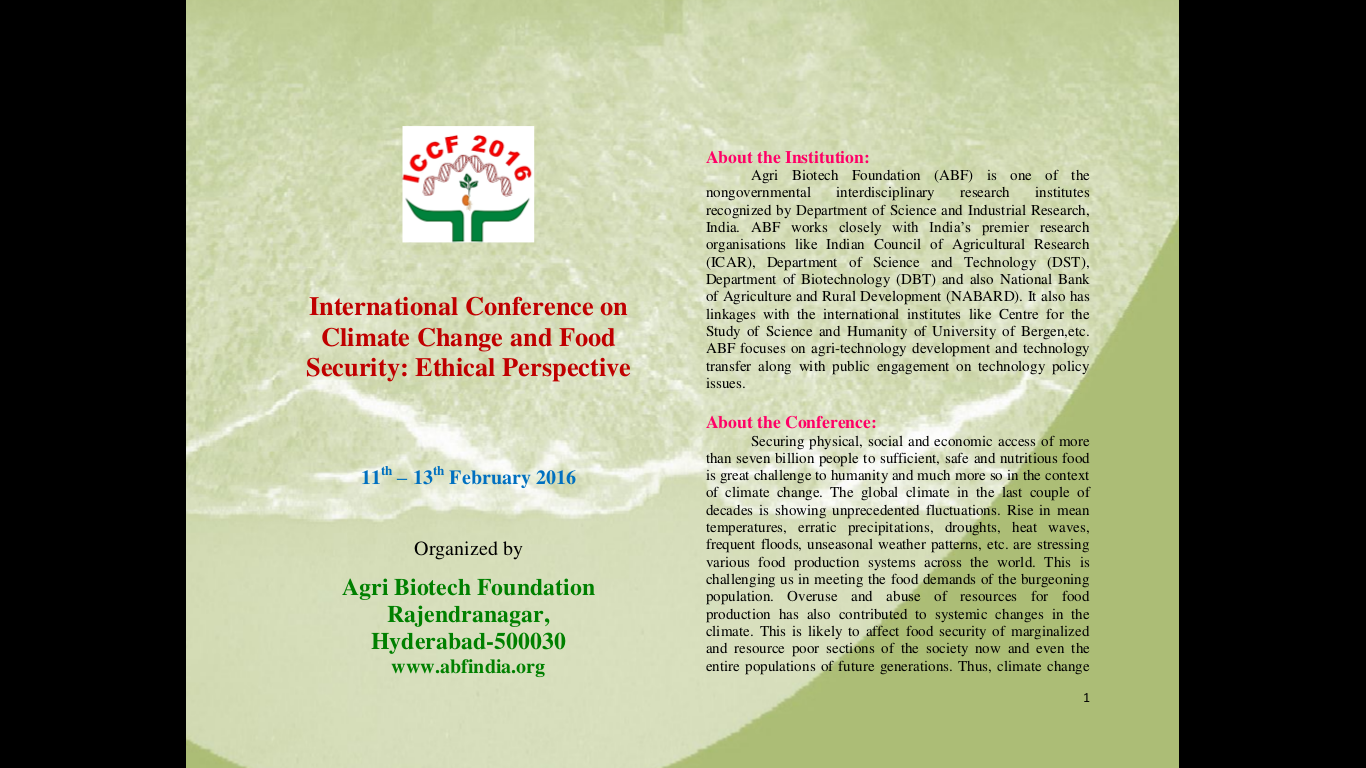
International Conference on Climate Change and Food Security: Ethical Perspectives

International Conference on Climate Change and Food Security: Ethical Perspectives, February 11-13, 2016, Hyderabad, India

Deadline of submission of abstract: September 25, 2015

For details please see inside.

This conference is the second international conference of the Asia-Pacific Society for Food and Agricultural Ethics (APSAFE), which organized its first conference at Chulalongkorn University in November, 2013.

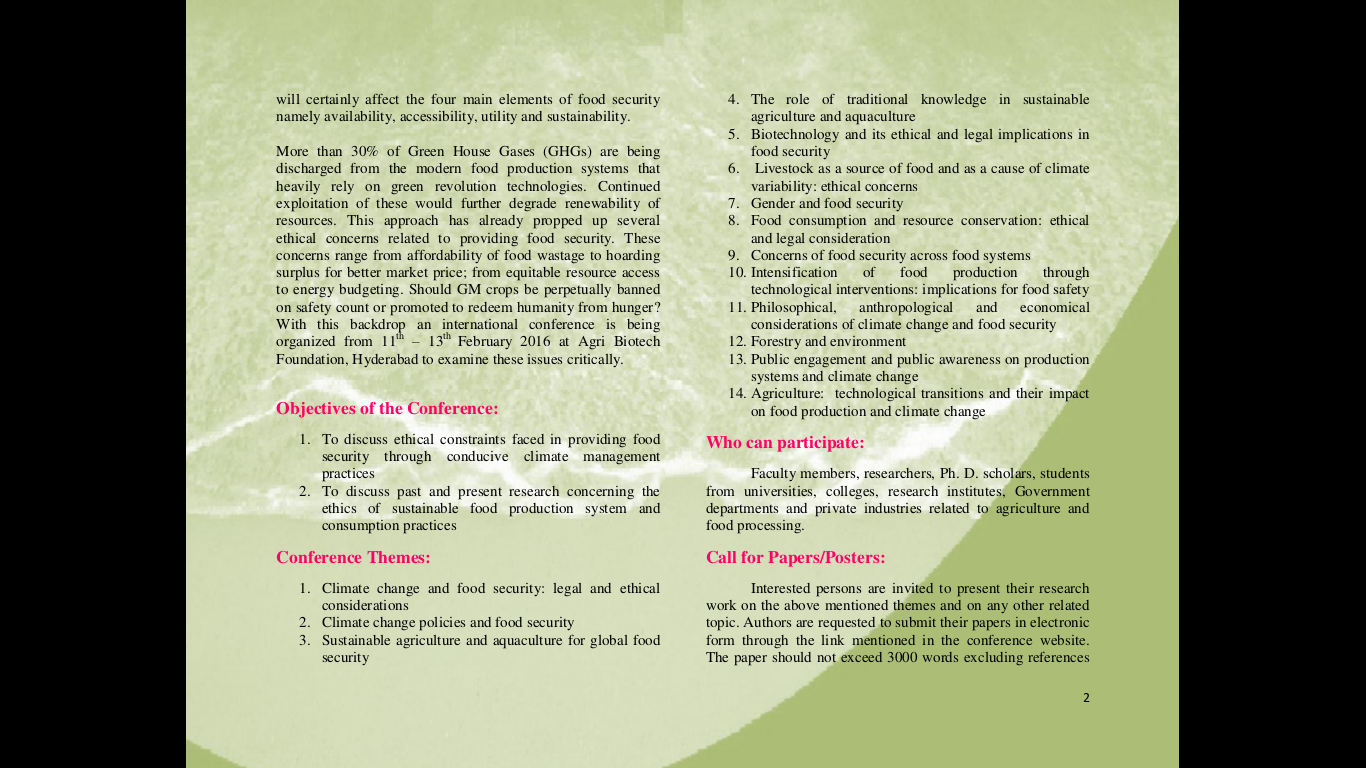
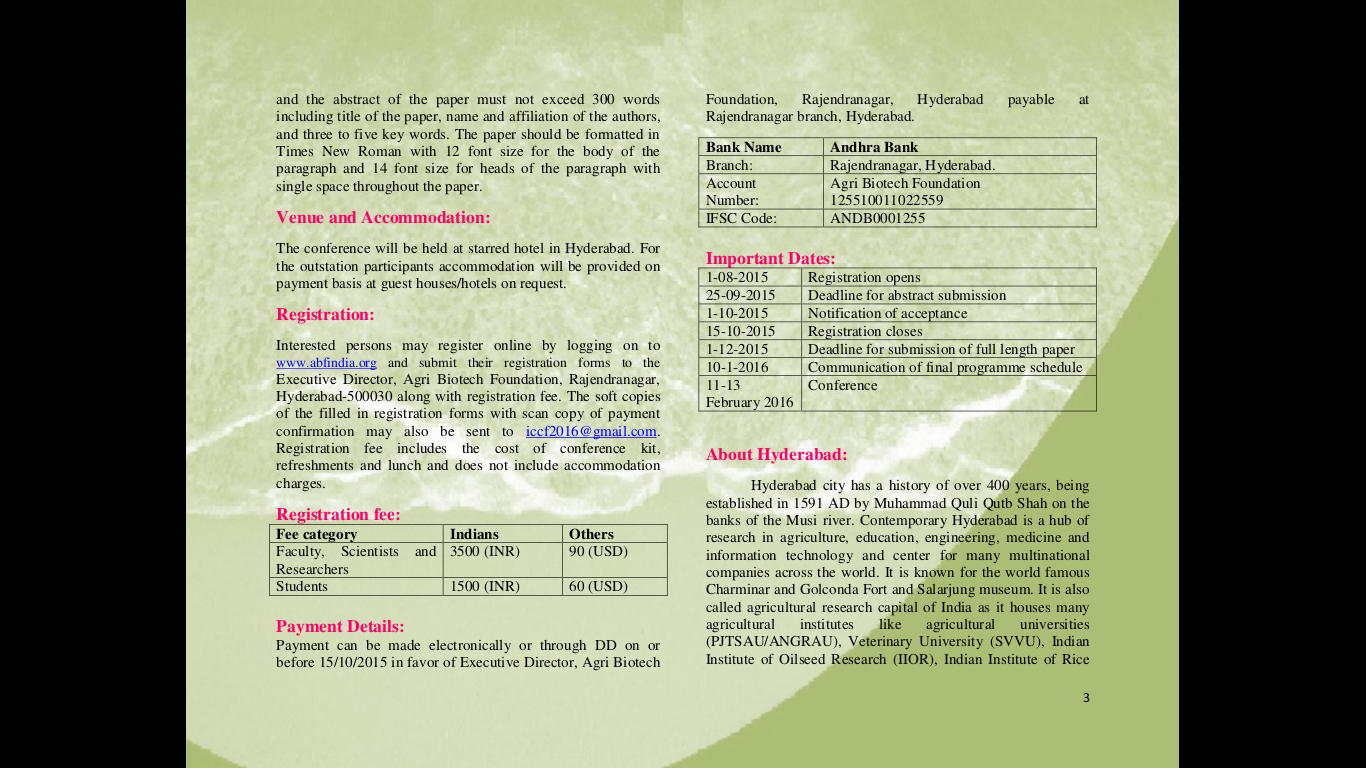
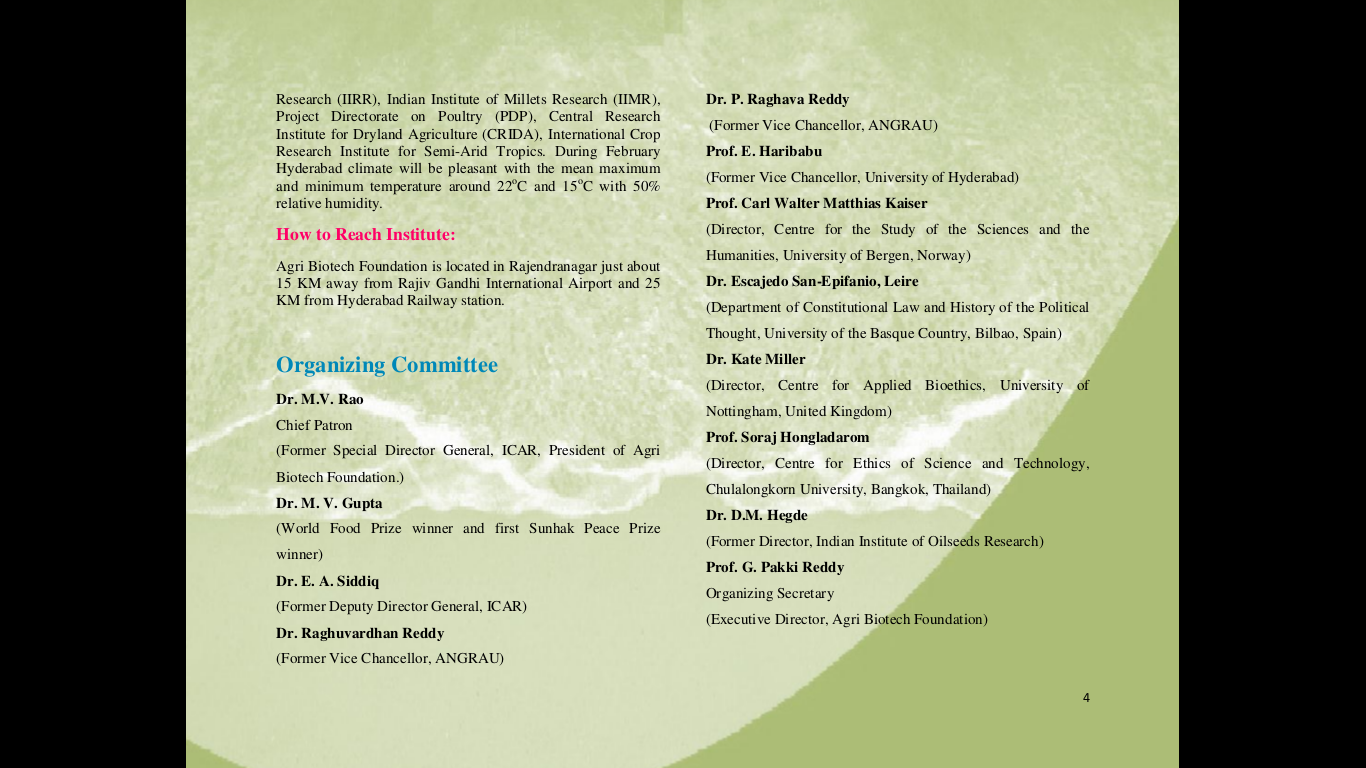
For details please see the following pictures:

Screenshot from 2015-08-13 22:04:15

Screenshot from 2015-08-13 22:04:24

Screenshot from 2015-08-13 22:04:36

Screenshot from 2015-08-13 22:04:47

Or the whole file can be downloaded here –> ICCF Brochure latest

Categories
ethics Uncategorized

Buddhism, Economic Ethics and the Ideal World of Gift Economy

You are invited to a talk on:
“Buddhism, Economic Ethics and
the Ideal World of Gift Economy”

by
Karma Lekshe Tsomo
Department of Theology & Religious Studies,
University of San Diego, U.S.A.,

and

Ursula Oswald Spring
Regional Center for Multidisciplinary Research, National Autonomous
University of Mexico

With reflection by Soraj Hongladarom

Friday January 17, 2014 at 13.00 hr., 4th Floor Meeting Room
Social Research Institute, Wisid Prachuabmoh Building
Chulalongkorn University, BANGKOK

The global economy is on the brink of collapse, yet we continue to hear news of corporate buy-outs, multi-million-dollar bonuses, and chronic corruption. What’s the solution? In this talk, Karma Lekshe Tsomo examines the teachings of the Buddha to discover ethical guidelines for economic decision making. Beyond rules and restrictions, she will explore the fundamental principles that could be used to construct an economic system in an ideal world. Ursula Oswald Spring will then introduce the concept of gift economy which is generally a non-category in economics, she will make a reference to mothering as a unilateral free distribution of goods and services and as a means of creating human bonds. She will also give some clues on how the world of gift economy may be attained through visibilizing and mainstreaming matriarchal spirituality. The talk will then be followed by a reflection from Soraj Hongladarom.

Categories
Uncategorized

First Digital Democracy Conference Bangkok

Center for Ethics of Science and Technology, Chulalongkorn University,
Siam Intelligence Unit (support by Thai Health Promotion),
Thai Netizen Network and Noviscape Consulting Group

20 November 2012, 9:00 – 16:00
Room 310 and Room 815, Maha Chakri Building,

Faculty of Arts, Chulalongkorn University, Bangkok

The Internet has revolutionized the way of communication and has become a global connection network for everyone. The new level of connectivity and computer-mediated social interaction has slowly changed not only digital awareness of citizens, in terms of access to communication and privacy, but has also increased political awareness and public participation in political issues. Furthermore, the Internet has become a channel for the voices of citizens enabling all kinds of new political forces. And soon the Internet itself could be a major political cause.
This conference aims to explore a wide field of digital democracy from different points of view. We would like to initiate a new multidisciplinary research field to explore the arising issues related to digital democracy, especially in Southeast Asia. Furthermore, we would like to reach policy makers and IT-professionals, in order to cross communicate between both groups, especially in the issues concerning the use of information and communication technologies and strategies in political and governance processes.
This one day conference consists of public and invited sessions. The morning session is open for the public with six 20-minutes talks on different topics concerning digital democracy. The afternoon session will be a discussion round in a closed group with invited guests. We would like to brainstorm new ideas for further field building in digital democracy and research tracks. Engaging trans-disciplinary ideas to formulate a cluster of knowledge excellence in digital technology and democratization.

Objectives:

1.    To build-up digital democracy as a new research and knowledge field in both higher educational institutes and other research-oriented organizations.
2.    To establish a group of researchers and practitioners from various disciplines in order to generate and disseminate knowledge and issues regarding to cyberspace participation, digital politics, rights and ethics, technological and social changes, and other forthcoming agendas relating to digital democracy in Thailand and other Asian countries.
3.    To create a high quality and dynamic space for ideas, openness, dignity, embracement, and inclusion for cyber-citizens and other bodies.

We would like to examine digital democracy from a number of perspectives throughout the conference. The topics are as following.

1. Socialization of digital technologies
Accessibility is the most important requirement of digital democracy (e.g. Internet accessibility in Thailand is still around 20-25%). The digital divide is not only an issue of physical accessibility e.g. lack of digital facilities, but also an issue for disabled people and senior citizens. The use of social and digital media for each institution needs to be inclusive, otherwise the prevailing digital divide – between the haves and have-nots – will prevent certain groups of citizens to actively take part in this so-called participatory governance. This raises the issue of fairness – fair and equal involvement of all citizens, otherwise it will lead to the segregation of the citizens and create second-class citizens – those who are disconnected.

2. Technological innovation and political space
Open government is a governance approach, which encompasses the principles of “information transparency, public engagement, and accountability”. Open government, however, requires a holistic approach on policies, the legal and regulatory framework, institutional structure, and process. An overall strategy or direction, at both the national and agency-level, on the use of social media should be in place. Without this, it might lead to confusion for both officers and citizens. For example, what kind of information should be released or communicated on official channels and what should be done via social media and who should be in charge.

3. Digital space & communication style
New media and hate speech: Political discussions seem to be more heated online. How can we respond to hate speech or even identify any content as such? How can we establish a constructive discussion culture?
Digital censorship and self censorship: The extent of Internet Censorship varies on a country-to-country basis. Moreover, some countries have little Internet Censorship, while other countries go as far as to limit the access of information to such matters as the news and suppress discussion among the internet population. Internet Censorship also occurs in response to or in keenness of events such as elections, protests, and riots. Governments across Southeast Asia share different degrees of authoritarian style digital censorship. Governmental monitoring of internet usage and blocking of international sites can be seen in Burma, Cambodia, the Philippines, Thailand, and Vietnam (Doherty, 2010). It is likely that censorship will be increased due to the events of the Arab Spring, Thailand’s Political Turmoil, and Myanmar political unrests.

4. Institutionalization of digital politics
ON-OFF line: The line between online and offline participation in politics is disappearing. How can we channel online enthusiasm into real-world action? What can we learn from online petitions or online recruitments for political purpose in Thailand? What can we learn from Malaysia with its strongest digital politics movement in Southeast Asia?
Political Party & Cyberspace: What could we do for more digital democracy? Does it have to be a political party? Is it enough to establish a movement? (e.g. BIG Trees project and Bangkok Bicycle Campaign). What does an initiative need to become a movement? (e.g. mainstreaming, sharing bite-size information that people can feel connected).

5. Digital security:
Security is a timely issue among governmental agencies. Apart from traditional security that has been associated with national defense and international diplomacy, a non-traditional security issue emerges from “grand challenges” like natural disasters, change of technological regime, emerging diseases or climate change, and other new threats, become a new normal of daily life. Digital technology accelerates social change and the way national security being conform. New key players have more involvement with both security domains. In this aspect, digital security is a bridge between traditional and non-traditional security and will ultimately blur the existing paradigm on categorization of social and security institutions.

6. Strategy and internationalization of digital politics
Digital Democracy in SEA context: Considering the ASEAN members, e-Participation in the region, with the exception of Singapore, does not seem to be progressing satisfactorily. In 2012, for example, Malaysia and Brunei are in the top twenty rankings, while Thailand, Indonesia, the Philippines, and Vietnam have managed to be ranked within the top thirty, whereas data prohibits meaningful rankings for Myanmar, Cambodia and Laos. The utilization of digital and social media by government agencies in those countries to reach out to their citizens is not a common practice. ASEAN governments in general, and Thailand in particular, have not yet been able to capitalize on the popularity and tremendous growth of social media despite the obvious growth of social media use among their citizens. How is the use of digital media in political issues in other countries in Southeast asia? What can we learn from their situation?

Program (Tentative)

Public session: Room 310, Maha Chakri Building

9:00 – 9:30
Registration

9:30 – 9:45
Introduction and opening remarks, Dr. Jittiporn Chaisaingmongkol
Speaker session hosted by Dr. Pun-Arj Chairatana

9:50 – 10:10
Socialization of digital technologies: Digital divide, Dr.Kasititorn Pooparadai, NECTEC

10:10 – 10:30
Net Neutrality, Dr. Soraj Hongladarom, Chulalongkorn University

10:30 – 10:50
Digital security, Dr. Teeranan Nandhakwang

10:50 – 11:10
Digital space & communication style: New media and hate speech, Dr. Pirongrong Ramasoota Rananand, Chulalongkorn University

11:10 – 11:30
Countering Hate Speech: Wikipedia as a Socio-technical Solution?, Dr. Chanchai Chaisukkosol

11:30 – 11:50
Institutionalization of digital politics: ON-OFF line, Sombat Boonngamanong

11:50 – 12:00
Closing remarks for public session

12:00 -13:00
Lunch

Invited session:  Room 815, Maha Chakri Building

13:00 – 14:30
Roundtable discussion I hosted by Pichate Yingkiattikun

14:30 – 14:45
Coffee break

14:45 – 15:45
Roundtable discussion II

15:45 – 16:00
Closing and concluding remark by Dr. Soraj Hongladarom

Categories
Uncategorized

จุฬาลงกรณ์มหาวิทยาลัยสู่ความเป็นนานาชาติ

กำหนดการสัมมนาวิชาการ
เรื่อง “จุฬาลงกรณ์มหาวิทยาลัยสู่ความเป็นนานาชาติ”
วันศุกร์ที่ 24 สิงหาคม พ.ศ. 2555 เวลา 08.30 – 12.00 น.
ณ ห้องประชุมสารนิเทศ ชั้น 2 หอประชุมจุฬาลงกรณ์มหาวิทยาลัย
…………………………….
พิธีกรผู้ดำเนินรายการ : ผู้ช่วยศาสตราจารย์ นายสัตวแพทย์ ดร.ชาญณรงค์ รอดคำ
08.00 – 08.45 น. ลงทะเบียน
08.45 – 09.00 น. พิธีเปิดการสัมมนา กล่าวรายงาน
โดย รองศาสตราจารย์ ดร.โสรัจจ์ หงศ์ลดารมภ์
ประธานคณะกรรมการวิชาการ
กล่าวเปิดการสัมมนา
โดย ศาสตราจารย์ นายสัตวแพทย์ สมชาย จันทร์ผ่องแสง
รองประธานสภาคณาจารย์
09.00 – 10.00 น. บรรยาย “วิสัยทัศน์ของจุฬาลงกรณ์มหาวิทยาลัยด้านความเป็นนานาชาติในอีก
3 ปีข้างหน้า”
โดย ผู้ช่วยศาสตราจารย์ ดร.ม.ร.ว.กัลยา ติงศภัทิย์
รองอธิการบดีฝ่ายวิชาการ

10.00 – 10.45 น. บรรยาย “บทบาทของ ASEAN University Network
และการส่งเสริมความเป็นนานาชาติของมหาวิทยาลัย”
โดย รองศาสตราจารย์ ดร. นันทนา คชเสนี
ผู้อำนวยการบริหารเครือข่ายมหาวิทยาลัยอาเซียน
ASEAN University Network (AUN)

10.45 – 11.00 น. – พักรับประทานอาหารว่าง –

11.00 – 12.00 น. บรรยาย “ดัชนีชี้วัดความเป็นนานาชาติของมหาวิทยาลัยไทยและบทบาทในเวทีโลก”
โดย ศาสตราจารย์กิตติคุณ ดร. สุจิต บุญบงการ
กรรมการสภามหาวิทยาลัย ผู้ทรงคุณวุฒิ

12.00 – 12.30 น. อภิปรายแลกเปลี่ยนความคิดเห็น สรุปผลการสัมมนา

Categories
Uncategorized

Erwin Schadel on Nishitani

Erwin Schadel will also give a small informal talk on “Absolute Nothingness as Selfless Self” at Room 1028, Faculty of Arts Building (Boromratchakumari Bldg.) at 10 am. Everyone is invited.

Erwin Schadel is professor of philosophy at Bamberg University, Germany. He is interested in early modern Western philosophy, especially the thoughts of Liebniz and Comenius. He is also very interested in how music is related with the world and with metaphysics. One of his books is on “Music as a Symbol of the Trinity: An Introduction to the Metaphysics of Harmony” (Musik als Trinitätssymbol. Einführung in die harmonikale Metaphy­sik).

For more info please contact Parkpume at parkpume@gmail.com

Categories
Uncategorized

Meaningful Broadband Forum Event Postponed

Dear all,

This is an urgent announcement. The Meaningful Broadband Forum that has been originally scheduled on October 28 (tomorrow) will be postponed. The new date and time will be announced as soon as these are available. I am very sorry for the inconveniences.

Best wishes,
Soraj

Categories
Uncategorized

Hello world!

Welcome to WordPress.com. This is your first post. Edit or delete it and start blogging!

Categories
Uncategorized

Broadband to the fore

New working group unites the biggest players in the industry.

By: Roger Sansuchat
Published: 4/03/2009 at 12:00 AM
Newspaper section: Database

http://www.bangkokpost.com/tech/technews/12708/broadband-to-the-fore

As it prepares to issue licences for 3G and WiMAX in Thailand, the National Telecommunications Commission (NTC) last week announced a new alliance with mobile operators. Called the Meaningful Broadband Working Group, it aims to produce an approach to broadband deployment, revive the economy, boost human resources and preserve Thai cultural and spiritual values.

At the announcement of the formation of the Meaningful Broadband Working Group are, from left to right: Craig Warren Smith of Chulalongkorn University; Todsaporn Simtrakarn, chief strategy officer at CAT Telecom; Tore Johnsen, chief executive officer, Dtac; Supachai Chearavanont, president and CEO, True Corp; and Ricky Corker, head of Asia North sub region for Nokia Siemens Network.

The announcement was a result of the Meaningful Broadband seminar last week hosted by Chulalongkorn University’s Centre for Ethics in Science and Technology, sponsored by Nokia Siemens Network.

Members of the alliance, apart from the NTC itself, include Dtac, True Corp and CAT, and efforts are underway to bring two other telecom operators, AIS and TOT, into the group.

Much of the impetus for this approach has come from the Obama administration in the US, which was the first government to put broadband into a starring role in economic stimulus. “We will use our participation in the working group to study carefully how the Obama team is using broadband to boost human resources and to see if the same approach could work in the new Thai economy,” said Sathit Limpongan, chairman of CAT. Last week, the Finance Ministry, where Satit is an official, announced a 1.9 trillion baht stimulus plan that incorporates investment in broadband infrastructure. In a speech that caused US Congress to agree to spend $9 billion on rural broadband infrastructure, one of Obama’s advisers said “data shows that a $17.4 billion investment in wireless broadband infrastructure could increase GDP by 0.88% to 1.28% – – a gain of $126.3 billion to $184.1 billion in dollar terms – and create 4.5 million and 6.3 million additional jobs over the two-year forecast period of 2009-2010.

“In the same way, Thai stakeholders could align broadband with the Thai government’s efforts to overhaul its economy,” said Craig Warren Smith. Smith is a former Harvard professor of science and technology policy who is in Thailand to organise the Meaningful Broadband initiative.

“A broadband approach to economic stimulus would not take years to produce jobs,” said Smith. “The benefits would begin to occur in a matter of months.”

“Now that legal hurdles are being removed, there is an urgent need for ICT stakeholders in Thailand to pool research efforts and formulate policies and practices that will make broadband of optimal benefit for all Thais,” said Prof Setaporn Kuseepitak of the NTC.

“Though Thailand doesn’t score high on technical indicators,” said Ricky Corker, Head of Asia North sub region for Nokia Siemens, “broadband could have a powerful effect on the country’s human resources, creating jobs and new entrepreneurial businesses,” he said. “Thanks to the academic, corporate and governmental cooperation expressed at Chulalongkorn, Thailand could produce the innovations that allow it to move into the ranks of global innovators in broadband technologies.”

“Telecommunications has emerged as the leading growth sector in Thailand’s economy. This effort hopes to find new ways to leverage the industry’s strength for the benefit of all Thais,” said Professor Prasit Prapinmongkalkarn, an NTC commissioner.

“Being meaningful means being affordable,” said Dtac CEO Tore Johnsen. “We are keen to share our experience in extending broadband to every Thai citizen no matter where they work or live.”

“Broadband applications can harm Thai citizens as well as help them,” added Supachai. “Though our participation in this working group, we want to make sure that broadband has the best possible ethical impacts on this country.”

The next step for the working group, say its members, is to invite Prime Minister Abhisit Vejjajiva to join a discussion about how broadband could assist the policy goals of a whole range of ministries.

Roger Sansuchat, fellow, Centre for Ethics of Science and Technology, Chulalongkorn University.

Categories
Uncategorized

News Release

Market Leaders, Regulators Join for “Meaningful Broadband”

Chulalongkorn University, February 24, 2009

In the first alliance of its kind, Thailand’s top mobile executives today joined an alliance with the country’s telecommunications regulators, intent on paving the way for “meaningful” broadband” which they think could boost and transform the country’s economy.

Though new data for OECD (oecd.org) and elsewhere suggests that broadband by itself stimulates economies, the coalition aims to enhance this benefit through by formulating regulatory innovations, public-private partnerships, new economic modeling and innovations in software design.

“Now that legal hurdles are being removed, there is an urgent need for ICT stakeholders in Thailand to pool research efforts and formulate policies and practices that will make broadband of optimal benefit for all Thais.” said Prof Setaporn Kuseepitak of the National Telecommunications Commission (NTC.) Besides NTC, also joining the Meaningful Broadband Working Group were chairmen and CEOs of the country’s powerful telecommunications operating companies including AIS, DTAC, True Corp., and CAT. (Participation of TOT
was pending confirmation as of Feb 23.)

The announcement of the new alliance was made at Chulaongkorn University in an event sponsored today by Nokia Siemens Network and hosted by the chairman of the university’s governing board, Dr. Charas Suwanwela. The Working Group was founded by the University’s Center for Ethics of Science and Technology (CEST.)

“Building on the approach used by the Obama Administration in the United States, the coalition puts high-speed internet in a starring role in a model of economic stimulus. But the approach goes further by also seeking to do so in a way that preserve Thai values and fosters a ‘sufficiency economy,’,” said University of Washington’s Craig Warren Smith, one of the founders of the worldwide movement to close Digital Divide. He is now a visiting professor at Chulalongkorn based at the CEST where he is helping to organize the Working Group.

“Telecommunications has emerged as the leading growth sector in Thailand’s economy. This effort hopes to find new ways to leverage the industry’s strength for the benefit of all Thais,” said Professor Prasit Prapinmongkalkarn, an NTC Commissioner.

“ We are delighted to support this initiative,” said Mr. Ricky Corker, Country Director of Nokia Siemens Networks Thailand. “As a leading global enabler of telecommunications services, we’re committed to building a sustainable future for broadband. With the kind of cooperation expressed by the Working Group, Thailand can emerge as a global innovator in broadband development,” he added.

“The working group can help us to consider how broadband can boost human resources in the new Thai economy,” said Mr. Sathit Limpongan, Chairman of CAT, who doubles as Thailand’s Deputy Finance Minister. Last week, the Finance Ministry announced a 1.9 trillion baht stimulus plan that incorporates investments in broadband infrastructure.

Being meaningful means being affordable,” said DTAC CEO Tore Johnsen. “We are keen to share our experiences in extending broadband to every Thai citizen no matter where they work or live.”

“Content is a driver of broadband,” said Supachai Chearavonont President and CEO of True Corp, a diversified media corporation that is also the third largest mobile company. “Though this collaborative effort we seek a way to extend access to interactive learning for even the most low-income Thais.”

“Six years ago, the Kingdom of Thailand became a world innovator by building a public/private alliance for the first national low-cost PC project. Now, with broadband, stakeholders can go so much further,” said Andrew McBean, former country director of Microsoft-Thailand.

The next step for the Working Group, say its members, is to invite the Kingdom of Thailand’s Prime Minister Abhisit to join a discussion about how broadband could assist the policy goals of a whole range of ministries.

Categories
Uncategorized

Report of the Symposium on "Buddhism …

Report of the Symposium on “Buddhism in German Philosophy and Literature”

Chulalongkorn University
February 6 – 7, 2009

Nineteenth century Germany saw an influx of ideas flowing in from the East. It is well known that thinkers such as Schopenhauer in the early period of the century was influenced by Indian philosophies such as Buddhism and Hinduism, as new translations became available in European languages or key canonical texts such as many Buddhist sutras and the Bhagavadgita. Thus the age was an important fermentation period, one that profoundly changed the outlook of many aspects of European culture, most notably perhaps in Germany itself. Through Schopenhauer the ideas received from the East percolated through thinkers and writers as diverse as Richard Wagner, Friedrich Nietzsche, Thomas Mann, and perhaps a little surprisingly Bertold Brecht.

The Symposium on “Buddhism German Philosophy and Literature: An Intercultural Dialogue” was held at the campus of Chulalongkorn University from February 6 to 7, 2009, and it was quite well attended, considering that there are many events in the university and the specific nature of the topic. The meeting was supported by the Goethe-Institut in Bangkok, and was jointly organized by the Center for European Studies and Center for Ethics of Science and Technology, both belonging to Chulalongkorn University, and the Thousand Stars Foundation, an independent non-profit focusing on research and other activities in Buddhism in Thailand.

After the opening the ceremony presided by Prof. Dr. Pirom Kamolratanakul, President of the university, the session in the morning of Friday, 6 February began with a brief talk on “Remarks on Philology and Buddhist Studies, with Special Reference to German Philology and Manuscript Studies” by Dr. Peter Skilling. He provided the audience with some details about German contribution of scholarship on Buddhist studies. The next paper was by Prof. Volker Mertens on “Buddhism in the European Middle Ages,” where he talked about the reception of Buddhist ideas through Europeans who get the opportunity for contact with the East during the 11th century when the Mongols were in their ascendancy. This was perhaps the first record of European contact with Buddhism (not counting the Romans or the Greeks, where the evidence was not clear).

Then the papers by Prof. Dr. Pornsan Watananguhn and Prof. Dr. Dr. h.c. Heinrich Detering investigated the influences and the reception of Buddhist ideas in German literature. The authors discussed were Karl Gjellerup, the Danish writer whose work “The Pilgrim Kamanita” was very well known in Thaiand through translation, Thomas Mann, Hermann Hesse, and Bertold Brecht. The reception of Buddhism by these writers was both positive and negative. As these writers became aware of Buddhist ideas, they gave their own responses, which were reflected in their writings. Thomas Mann, for example, was deeply influenced by Schopenhauer, and the idea of the unknowable will and the Buddhist conception of suffering figures prominently in the discussion during the Symposium.

Three more papers dealed with Buddhist influences in German literature, namely those by Prof. Dr. Dr. h. c. Dieter Borschmeyer, who focused on Mann’s “Die vertauschten Köpfe,” and Dr. Ronald Perlwitz, who talked about the writer Friedrich Rückkert and his views on Buddhism. Finally, Prof. Dr. Adrian Hsia talked about Hermann Hesse and his “transcultural reception” blending Buddhism, Hinduism, Protestantism and Catholicism together.

Then there were papers by Thai philosophers, starting with a keynote address by Prof. Preecha Changkwanyuen, whose paper was entitled “Exchange of Religious Cultures between East and West.” Then Prof. Dr. Somparn Promta talked about “Literature in Buddhist Perspective,” which though it did not touch upon the question of reception of Buddhism in German culture directly, did in fact contribute significantly through his analysis of literature according to Buddhism. Afterwards there were two more papers, by Dr. Soraj Hongladarom and Dr. Theptawee Chokevasin, whose topics were “Schopenhauer’s Metaphysics of the Will and Nagarjuna’s View on Emptiness” and “Heideggian and Theravada Buddhist View on the Motility of Life” respectively. Dr. Soraj’s paper was a detailed analysis of Schopenhauer’s argument compared with the Buddhist master Nagarjuna. The topic was what was actually meant by “nothing.”

The Symposium ended with a session where everybody convened and gave their viewpoints on a variety of topics. Not surprisingly the topics of Buddhist and Christian dialogs dominated the discussion. The participants talked about how Buddhism and Christianity could be reconciled, and how much of the ideas of pantheism and the philosophy of Spinoza (which, by the way, perhaps found its way into Schopenhauer) could be found in these literary works.

That was to be expected from an academic meeting. The participants in any case agreed that there should be a second meeting after this one. The topic is far too important and too rich just to let this particular event pass by without any further action.