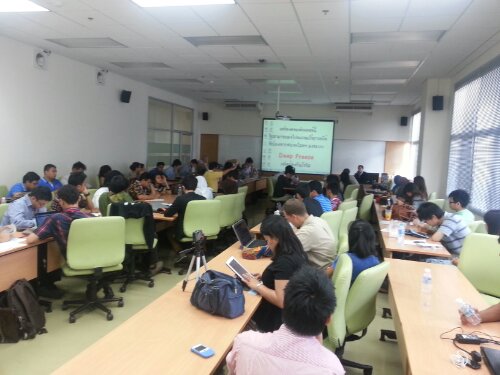
This is a live picture of the workshop on “Ethics in Action” at Chulalongkorn University. It’s part of the Sixth Youth Peace Ambassador Training Program directed by Darryl Macer and organized by the Center.
This is a live picture of the workshop on “Ethics in Action” at Chulalongkorn University. It’s part of the Sixth Youth Peace Ambassador Training Program directed by Darryl Macer and organized by the Center.
‘Meaningful’ broadband policy sought
By Asina Pornwasin
The Nation
The National Telecommunications Commission (NTC) and the Digital Divide Institute of Chulalongkorn University’s Faculty of Arts have jointly proposed guidelines for the creation of a broadband policy which they say should have a meaningful impact on Thai society.
The proposal is a result of two years’ work by the university’s Meaningful Broadband Working Group to develop a framework, or research agenda, from which a broadband roadmap can be developed. It has proposed the creation of innovations in five domains and integrating them into a coherent model.
NTC chairman Prasit Prapinmongkolkarn said broadband policy was an outcome of integrating governmental policy with industry policy, a regulatory framework and public-private partnerships in rolling out meaningful applications and services for broadband.
“After years of postponement, Thai policy-makers are now rapidly formulating plans for bringing broadband to all Thais. Mobile broadband is a strategically important solution, in addition to implementing broadband access in the form of fixed optical fibre to the home. Now, 3G is finally on its way [with a licence auction later this month]. The challenge is to leverage the licensing of broadband to make sure all Thais benefit from it,” Prasit said.
To make national broadband policy effective, innovative elements are required from five “domains”, labelled governmental, technology, management, ethics and financial, Prasit said. Then, these innovative elements must be integrated into a coherent model.
He said the governmental innovation should find the right link between the regulatory policies of the NTC and the public policies of the Cabinet. The government must also consider how to use instruments such as tax abatement, public-private partnerships, public-private actions and state-owned enterprises to lessen risks and increase rewards for companies that introduce useful broadband services.
In the technology domain, the government should find technologies, including software, devices and last-mile solutions, to activate broadband demands in Thailand.
“The government should encourage academic talent to develop software and solutions to make broadband services usable and affordable for all Thai people,” he said.
However, collaboration between the government and academics is not enough. The government should invite private-sector organisations to bring broadband access to the masses, especially upcountry. To effectively execute these things, a management model is required, and private-sector companies are expert in these matters, he said.
The Meaningful Broadband Working Group has also suggested that the government should be concerned about the downside of broadband.
Prasit said Chulalongkorn University’s Centre of Ethics in Science and Technology was currently formulating a research tool called a “meaningful technologies index”. It is an attempt to measure the difference between “good” and “bad” impacts of broadband.
“The government should not only focus on the social and economic benefits of broadband, but also the harm that broadband technologies bring, such as the risk of online-game addiction. This is one problem that could result if broadband deployment is not meaningful,” he said.
Finally, the government should initiate studies to determine the best financial model for making broadband access meaningful for all stakeholders.
สมุดปกขาว ถึง สำนักงานคณะกรรมการกิจการโทรคมนาคมแห่งชาติ
โดย เครก วอร์เรน สมิทธ์ ปี 2552
ศูนย์จริยธรรมวิทยาศาสตร์และเทคโนโลยี จุฬาลงกรณ์มหาวิทยาลัย
บทคัดย่อ
รายงานฉบับนี้ เรื่องบรอดแบนด์ที่เป็นประโยชน์ต่อสาธารณชนประเทศไทย ทำขึ้นภายใต้การร้องขอของ สำนักงานคณะกรรมการกิจการโทรคมนาคมแห่งชาติ จะนำเสนอถึงขั้นตอนต่างๆในอันที่จะนำอินเตอร์เนตความเร็วสูงมาสู่ประเทศไทย อย่างรวดเร็ว ในระดับลึก และมีประโยชน์ต่อสาธารณชน รายงานฉบับนี้ยังสนับสนุน การทำงานของคณะทำงานโครงการบรอดแบนด์ที่เป็นประโยชน์ต่อสาธารณชนประเทศไทย (Meaningful Broadband Working Group – MBWG) ซึ่งเป็นความร่วมมือระหว่างกลุ่ม ผู้กำกับดูแล และ กลุ่มผู้ประกอบการโทรคมนาคม ซึ่งการประชุมอย่างเป็นทางการได้จัดไปเมื่อ วันที่ 2 กรกฎาคม 2552 ที่ผ่านมา ณ โรงแรมโอเรียนเต็ล กรุงเทพฯ
การนำพาไปสู่การสร้างมูลค่าเพิ่ม
รายงานฉบับนี้จะให้คำแนะนำว่าคณะทำงานโครงการบรอดแบนด์ที่เป็นประโยชน์ต่อสาธารณชน จะเติมเต็มช่องว่างที่เกิดจากการขาดนโยบายภาครัฐที่ชัดเจนเกี่ยวกับระบบ อินเตอร์เนตความเร็วสูงในประเทศไทยภายใต้การบริหารงานของรัฐบาลชุดปัจจุบัน นอกจากคำแนะนำในการที่จะทำให้เกิดการขับเคลื่อนโดยนายกรัฐมนตรี คณะรัฐมนตรีและ สำนักงานคณะกรรมการพัฒนาการเศรษฐกิจและสังคมแห่งชาติ ในประเด็นเรื่องอินเตอร์เนตความเร็วสูงแล้ว รายงานฉบับนี้ยังเสนอแนะให้สมาชิกของกลุ่มคณะทำงานนี้สามารถดำเนินการเกี่ยวกับประเด็นที่สำคัญที่สุดได้ทันที่ นั่นคือ : การพัฒนาตลาดอินเตอร์เนตความเร็วสูงให้กับผู้ด้อยโอกาสได้อย่างรวดเร็ว และจะกลายมาเป็นโครงการพัฒนาตลาดแห่งประวัติศาสตร์ ที่ผู้ประกอบการไทยทุกกลุ่มจะมีส่วนร่วม ที่จะนำพาให้ประเทศพ้นไปจากตลาดกลุ่มผู้ใช้เครื่องมือสื่อสารอย่างฟุ่มเฟือย (“yuppiephone”) ที่มีคนไทยเพียงร้อยละ 30 ที่มีรายได้สูงสุดเท่านั้นที่มีแนวโน้มที่จะใช้บริการอินเตอร์เนตความเร็วสูงผ่านโทรศัพท์มือถือ จากปัจจุบันจนถึงปี 2557
หากมองให้พ้นตลาดระดับบนขึ้นไป จะพบว่า โครงการบรอดแบนด์ที่เป็นประโยชน์ต่อสาธารณชนจะช่วยให้เราพิจารณาวิธีที่จะรองรับคนไทยผู้ใช้เครื่องมือสื่อสารจำนวน 28 ล้านคนในระดับรายได้ที่ต่ำถัดไป ที่ ณ ปัจจุบันแอพพลิเคชั่นเกี่ยวกับอินเตอร์เนตความเร็วสูงในโทรศัพท์ของพวกเขา ไม่สามารถใช้ได้ มีราคาสูงเกินไป รวมทั้งไม่สร้างความสามารถในการพัฒนาตนเอง ซึ่งสิ่งเหล่านี้จะเปลี่ยนไป รายงานฉบับนี้จะชี้ให้เห็นว่าสมาร์ทโฟนและเน็ทบุ้คจะสามารถส่งผ่านบริการที่ จะสร้างมูลค่าเพิ่ม (Wealth Effect) ที่การบริการทางการเงินผ่านมือถือรวมเข้ากับแอพพลิเคชั่นที่สำคัญของสมาร์ท โฟน (รวมทั้งบริการจากภาครัฐที่สำคัญอื่นๆ) จะช่วยลดค่าใช้จ่ายและเพิ่มรายได้ให้กับประชากรกลุ่มนี้
การสร้างมูลค่าเพิ่มนี้ไม่ใช่เรื่องเล็กๆ ไทยเป็นหนึ่งใน 16 ประเทศทั่วโลกที่ประชากรส่วนใหญ่อยู่ตรงกลางของปิรามิด (Middle of Pyramid หรือ MOP) ตามการจัดอันดับรายได้ตามแนวทางของเศรษฐกิจโลก ซึ่งมีอยู่ประมาณ 2 พันล้านคนทั่วโลกที่มีรายได้ระหว่าง 2 – 6 ดอลลาร์สหรัฐต่อวัน คนเหล่านี้มีรายได้ต่อหัวต่ำกว่าเกณฑ์มาตรฐานตามเกณฑ์ของบริษัทผู้ให้บริการ อย่างเอไอเอส ดีแทค ทรู หรือฮัทช์ แต่ความมั่งคั่งของคนกลุ่มนี้มีค่าเท่ากับ 48.5 % ของผลิตภัณฑ์มวลรวมภายในประเทศ นักเศรษฐศาสตร์ยังกล่าวด้วยว่าคนกลุ่มนี้คือฐานที่มาสำคัญของอุปสงค์ที่ยัง ไม่ได้ถูกปลดปล่อยออกมา และยังเป็นฐานที่สำคัญยิ่งของประชากรชนชั้นกลางของโลกในอนาคต การใช้โทรศัพท์เคลื่อนที่ของพวกเขาเพื่อกระโดดข้ามพ่อค้าคนกลาง จะทำให้ส่วนแบ่งจีดีพีของผู้มีรายได้อยู่ตรงกลางของปิระมิด มีสัดส่วนสูงขึ้น 1.3% ต่อปี เป็น 62% ในปี 2017
การเข้าสู่การร่วมมือในการสร้างตลาดนี้ บริษัทเหล่านั้นไม่เพียงแต่จะเป็นผู้สร้างตลาด แต่เหมือนเป็น ผู้สร้างชาติ อีก ด้วย พวกเขาเหล่านั้นจะกลายเป็นผู้กล้าสำหรับประเทศที่รัฐบาลของตนไม่สามารถหา แนวทางในการนำผลประโยชน์จากตลาดโลกมาสู่ประชากรส่วนใหญ่ของประเทศ
ยิ่ง ไปกว่านั้น การพัฒนาตลาดจะช่วยสร้างโอกาสให้กับผู้ประกอบการไทย ที่สามารถจะส่งออกโมเดลทางธุรกิจที่เน้นกลุ่มประชากรตรงกลางของปิระมิดไปยัง ตลาดเกิดใหม่อื่นๆที่มีสัดส่วนของประชากรใกล้เคียงกัน
การกระตุ้นเศรษฐกิจในรูปแบบใหม่
รายงานฉบับนี้ถูกสร้างขึ้นบนพื้นฐานทางภาษารูปแบบใหม่ของนักเศรษฐศาสตร์ยุคปัจจุบัน พวกเขาใช้ข้อมูลด้านสถิติในการทดสอบทฤษฎีทางเศรษฐศาสตร์เพื่อ ทำนายผลการกระตุ้นเศรษฐกิจของการลงทุนด้านอินเตอร์เนตความเร็วสูง การศึกษาได้เชื่อมอินเตอร์เนตความเร็วสูงเข้ากับหลายๆปัจจัย เช่นการเพิ่มขึ้นของจีดีพี ผลิตผลของประเทศ (รวมทั้งผลิตผลของภาคส่วนอื่นๆเช่นการศึกษาและสาธารณสุข ไปจนถึงการเจริญเติบโตของวิสาหกิจขนาดกลางและขนาดย่อม การกระจายรายได้ การสร้างงานทั่วประเทศ การลงทุนที่เกิดขึ้นตามมา และการโปรโมทประเทศไทยในฐานะศูนย์กลางการลงทุนของภูมิภาค เป็นที่เห็นอย่างเด่นชัดว่า นักวิจัยได้สรุปว่าอินเตอร์เนตความเร็วสูงนั้นได้สร้างผลกระทบเป็นทวีคูณ เปรียบเทียบกับการกระตุ้นเศรษฐกิจในรูปแบบอื่นๆ การศึกษานี้ยังนำไปสู่การปรับแผนงบประมาณในกว่า 12 ประเทศ ที่ซึ่งองค์กรความร่วมมือใหม่ๆทั้งของภาครัฐและเอกชนได้นำงบประมาณสนับสนุน จากภาครัฐเข้าสู่กระบวนการธุรกิจที่ต้องการการสนับสนุนมากที่สุด จากมุมมองของประเทศไทย ตัวอย่างที่เกี่ยวข้องมากที่สุดคือการวางโครงสร้างพื้นฐานเส้นใยแก้วนำแสงมูลค่ากว่าสามหมื่นหนึ่งพันล้านเหรียญออสเตรเลียซึ่งออกแบบมาเพื่อกระตุ้นการฟื้นตัวของภาคชนบทของประเทศนั้น
อย่างไร ก็ตาม สำหรับประเทศไทย การศึกษาเหล่านี้ไม่ได้บอกถึงหนทางที่จะก้าวต่อไปข้างหน้า ในการโต้เถียงกันในแง่ของตัวเลขที่วัดได้ของการเพิ่มขึ้นของอินเตอร์เนต ความเร็วสูงและประโยชน์ที่จะได้รับตามมานั้นมักจะมีการละเลยถึงด้านลบอื่นๆ ของอินเตอร์เนตความเร็วสูงเช่น ภาวะการว่างงานอันเกิดจากการใช้เครื่องจักรที่มากขึ้น ความเป็นไปได้ที่อินเตอร์เนตความเร็วสูงจะสร้างความไม่เท่าเทียมให้เพิ่ม ขึ้นในสังคม และการเพิ่มขึ้นของพฤติกรรมการเสพติดการใช้เช่นการเล่นเกมส์ออนไลน์ การดูสื่อลามก รวมทั้งการส่งเสริมให้มีการใช้เวลาว่างไปอย่างเปล่าประโยชน์ในหมู่เยาวชน
นอกจากนี้ การศึกษาส่วนใหญ่ยังมักคิดผิดในเรื่องนิยัตินิยมทางเทคโนโลยี (technological determinism)
โดย เชื่อว่ามนุษยชาติไม่สามารถกำหนดอนาคตของเทคโนโลยีของตนเองได้ หากแต่ทำได้เพียงพยายามที่จะคาดเดาว่านวัตกรรมใหม่ๆที่เกิดขึ้นส่งผลต่อเรา อย่างไรเท่านั้น
แทนที่จะพยายามจะคาดเดาอนาคต คณะทำงานโครงการบรอดแบนด์ที่เป็น ประโยชน์ต่อสาธารณชนได้เสนอแนวทางที่ต่างออกไป นั่นคือการสร้างอนาคตของอินเตอร์เนตความเร็วสูงที่คนไทยต้องการจริงๆขึ้นมา ผู้นำของชาติจำเป็นต้องตระหนักว่าอินเตอร์เนตความเร็วสูงเป็นได้ทั้งโอกาส และอันตราย ด้านที่ดีของมันจะต้องถูกดึงออกมาใช้อย่างเต็มที่และ ด้านลบของมันต้องถูกทำให้ลดลงผ่านการปฎิบัติของผู้นำที่ฉลาด จุฬาลงกรณ์มหาวิทยาลัยจะสามารถให้ความช่วยเหลืออย่างมากในการเป็นแหล่ง ข้อมูลเชิงวิเคราะห์ที่ปราศจากอคตินี้
จุดจบของอุดมการณ์เรื่องการเปิดเสรีทางโทรคมนาคม
การ ตอบรับการใช้อินเตอร์เน็ตความเร็วสูงในประเทศไทยนั้นเกิดในช่วงการ เปลี่ยนแปลงแนวคิดเรื่องโลกาภิวัฒน์ การเปิดเสรีนั้นไม่ได้ผลเลย ประเทศไทยได้รับประโยชน์จากการเปิดเสรีของตลาดผู้ให้บริการโทรคมนาคม การที่รัฐบาลไม่แทรกแซงการทำงานของคณะกรรมการกิจการโทรคมนาคมแห่งชาตินั้น เป็นสิ่งที่ถูกต้อง แต่การดำเนินงานของคณะกรรมการกิจการโทรคมนาคมแห่งชาติก็ไม่ควรถูกแยกออกจาก การปฏิรูปนโยบายสาธารณะ ภายใต้ข้อบังคับของรัฐธรรมนูญ องค์กร กระทรวงหรือผู้ควบคุมบริการโทรคมนาคมสามารถวางโครงร่างของตลาดอินเตอร์เน็ต ความเร็วสูงได้ ไม่ใช่แค่ปล่อยให้เกิดการแข่งขันอย่างอิสระเพียงอย่างเดียว ในกรอบการทำงานนี้ “บทลงโทษ” ของข้อบังคับจะต้องผสมผสานกับ “รางวัล” ซึ่งได้แก่เงินสนับสนุนจากรัฐบาลและการลดภาษี เพื่อให้ได้ผลลัพธ์คือการทำให้อินเตอร์เน็ตความเร็วสูงเป็นประโยชน์มากยิ่งขึ้น
เรา สามารถเห็นได้ชัดเจนว่าการเปิดเสรีด้านการให้บริการทางการเงินนั้นลดลงอย่าง มากระหว่างวิกฤติในปี 2551 สำหรับธุรกิจโทรคมนาคมแล้ว ปัจจัยที่ขัดขวางการเปิดเสรีนั้นไม่ใช่วิกฤต แต่เป็นโอกาส อินเตอร์เน็ตความเร็วสูงนั้นถือเป็นโอกาสที่ล้ำค่าที่ภาครัฐบาลเริ่มนำมาใช้ มันเป็นสิ่งที่สำคัญเกินกว่าที่กลุ่มองค์กรใดองค์กรหนึ่งเพียงองค์กรเดียวจะ เป็นผู้กำหนดโครงสร้างทั้งหมดได้ รัฐบาลจึงต้องเข้ามาแทรกแซงการทำงานของภาคโทรคมนาคมเช่นเดียวกันกับภาคการ เงิน ถ้าหากมีการควบคุมที่เหมาะสม อินเตอร์เน็ตความเร็วสูงสามารถผลักดันให้เกิดผลดีหลายประการต่อสังคมไทย และยังสามารถเพิ่มอิสระภาพและประสิทธิภาพในการคิดเชิงสร้างสรรค์ให้แก่คนไทย ด้วย ซึ่งเป็นสิ่งสำคัญของ “นโยบายเรื่องอินเตอร์เน็ตความเร็วสูง”
ปัจจุบัน การไม่มีอินเตอร์เน็ตความเร็วสูงนั้นเป็นอุปสรรคในการพัฒนาประเทศ หลายหน่วยงาน เช่น กระทรวงการคลัง กระทรวงเทคโนโลยีสารสนเทศและการสื่อสาร กระทรวงวิทยาศาสตร์และเทคโนโลยี คณะกรรมการกิจการโทรคมนาคมแห่งชาติ และองค์การภาครัฐอื่นๆ ไม่สามารถปฏิบัติงานภายใต้กรอบการพัฒนาเดียวกัน สิ่งนี้ส่งผลให้อินเตอร์เน็ตความเร็วสูงเข้าถึงผู้ใช้ได้น้อย แผนการอนุมัติการนำโทรศัพท์ระบบ 3G และ Wimax ของ คณะกรรมการกิจการโทรคมนาคมแห่งชาติมาใช้ ได้รับการคาดหวังอย่างสูง แต่นี่เป็นเพียงขั้นเริ่มต้นเท่านั้น คณะกรรมการกิจการโทรคมนาคมแห่งชาติมิได้มีกรอบการพัฒนาจากภาครัฐให้อ้างอิง หากปราศจากกรอบดังกล่าว จะเป็นการยากที่จะบริหารจัดคลื่นความถี่ให้เหมาะสม ภายใต้สภาวะที่ไม่แน่นอนเช่นนี้ นักลงทุนจึงชะงักการลงทุนและยังส่งผลให้ภาครัฐดึงดูดนักลงทุนได้ยากขึ้นอีก ด้วย
นโยบายเรื่องอินเตอร์เน็ตความเร็วสูงจะเกิดขึ้นได้อย่างไร ประการแรกที่ต้องพิจารณาก็คืออินเตอร์เน็ตความเร็วสูงจะช่วยในการกำหนด “เป้าหมายเชิงนโยบาย” ของกระทรวงต่างๆ ซึ่งสามารถทำให้เกิดการเปลี่ยนแปลงอย่างมาก เช่น ในด้านการศึกษาและด้านการจ้างงาน คณะกรรมการพัฒนาเศรษฐกิจและสังคมแห่งชาติอาจต้องทบทวนนโยบายเรื่อง อินเตอร์เน็ตความเร็วสูงในแผนพัฒนาเศรษฐกิจและสังคมแห่งชาติฉบับใหม่ โดยหลังจากที่มีการกำหนดเป้าหมายของการใช้อินเตอร์เน็ตความเร็วสูงแล้วจึงจะ สามารถกำหนดวิธีการปรับเปลี่ยนระบบโทรคมนาคมที่ใช้อยู่ในปัจจุบันได้ โดยอาศัยการรวมตัวกับกลุ่มบริษัทผู้ให้บริการสายรับส่งสัญญาณข้อมูลหลัก (backbone) บริษัทให้บริการการเชื่อมต่อขั้นสุดท้าย (last mile) และผู้ให้บริการอุปกรณ์และข้อมูล สิ่งเหล่านี้ต้องได้รับการปรับโครงสร้างเพื่อให้เกิดประโยชน์สูงสุดแก่ ประเทศ ท้ายที่สุดนี้ คณะทำงานฯเสนอให้มีการศึกษาวิจัยในเรื่องนโยบายสาธารณะกับความสำคัญของ อินเตอร์เน็ตความเร็วสูง โดยจะเป็นความร่วมมือของคณะทำงานโครงการบรอดแบนด์ที่เป็นประโยชน์ต่อสาธารณชนและหน่วยงานรัฐบาลที่เกี่ยวข้อง ซึ่งรวมถึงสำนักนายกรัฐมนตรี
งาน วิจัยเหล่านี้มิได้ทำขึ้นเพื่อการศึกษาเท่านั้น แต่จะเป็นการช่วยให้ระบบโทรคมนาคมของประเทศเกิดความโปร่งใส เข้าถึงได้ และยังช่วยสร้างความเชื่อมั่นให้กับนักลงทุนอีกด้วย นอกจากนี้การศึกษาจะช่วยผลักดันคำถามที่ว่า ผู้ให้บริการโทรคมนาคม 5 รายหลักของประเทศ ได้แก่ บริษัท ทีโอที จำกัด (มหาชน) (TOT) บริษัท กสท.โทรคมนาคม จำกัด (CAT) บ.แอดวานซ์ อินโฟร์ เซอร์วิส จำกัด (มหาชน) (AIS) บริษัท โทเทิ่ล แอ็คเซ็ส คอมมูนิเคชั่น จำกัด (มหาชน) (DTAC) บริษัท ทรู คอร์ปอเรชั่น จำกัด (มหาชน) (True Corporation) จะสามารถสนับสนุนกันและกันเพื่อนำไปสู่วิสัยทัศน์เดียวกันได้หรือไม่ เครือข่ายนี้ไม่ได้จัดตั้งขึ้นเพื่อเพิ่มผลิตภัณฑ์มวลรวมภายในประเทศ (GDP) เท่านั้น แต่เป็นการเพิ่มประสิทธิภาพให้กับคนไทยทั้งประเทศอีกด้วย
สมาร์ทโฟนสามารถทำงานร่วมกันได้หรือไม่
หัวข้อนี้มีความคลุมเครือแต่ก็มีความสำคัญ “การทำให้ระบบที่ต่างกันทำงานร่วมกัน”คือ การมุ่งมั่นพัฒนาความร่วมมือที่จำเป็นต่อการขยายตัวของการใช้สมาร์ทโฟนและ เน็ตบุคในประเทศไทยเพื่อให้มีการทำงานร่วมกันได้ เพื่อให้สามารถใช้อินเตอร์เน็ตความเร็วสูงผ่านทางโทรศัพท์เคลื่อนที่ได้ทุก ระบบเหมือนกัน ถ้าหากรัฐบาลสามารถสื่อสารโต้ตอบกับประชาชนด้วยวิธีนี้ได้ ประชาชนก็จะรับฟังสิ่งที่รัฐบาลเสนอ ทางเลือกหนึ่งก็คือรัฐบาลจะต้องอนุมัติหน้าจอ (user interface) ที่ผู้ใช้สามารถใช้งานได้อย่างง่ายดาย ผู้ใช้งานจะได้รับประโยชน์จากการทำธุรกรรมผ่านโทรศัพท์เคลื่อนที่ (Mobile banking) การซื้อสินค้าทางอินเตอร์เน็ต (e-commerce) การศึกษาผ่านอินเตอร์เน็ต (e-learning) การปรึกษาด้านสุขภาพทางอินเตอร์เน็ต (e-Health) และการใช้บริการเครือข่ายสังคมออนไลน์ (Social networking) ซึ่ง จะจัดทำให้เหมาะสมกับความสามารถในการอ่าน เขียน ความต้องการด้านเศรษฐกิจ และรูปแบบการใช้ชีวิตของแต่ละคน นอกจากนี้รายงานยังได้เสนอแนะกลยุทธ์การเผยแพร่ข่าวสารที่สนับสนุนให้ นักศึกษาทั้งในประเทศไทยและในต่างประเทศสร้างเทคโนโลยีสารสนเทศที่ช่วยแก้ ปัญหาความยากจน โดยเฉพาะอย่างยิ่ง คณะทำงานต้องการสนับสนุนเยาวชนไทยผู้มีความสามารถที่กำลังศึกษาอยู่ที่ สถาบันเทคโนโลยีแมสซาชูเซตส์ (MIT) มหาวิทยาลัยสแตนฟอร์ด (Stanford University) และมหาวิทยาลัย Carnegie Mellon เป็นต้น รวมทั้งคนไทยที่ทำงานอยู่ในองค์กรระหว่างประเทศ เช่น Microsoft และ Google เพื่อ ให้กลับมาทำงานในมหาวิทยาลัยในประเทศไทย และเข้าร่วมในความพยายามครั้งประวัติศาสตร์ที่จะดำรงค์รักษาสิ่งที่ดีที่สุด ให้คงอยู่ในประเทศในขณะที่เราก้าวสู่อนาคต บทบาทของอินเตอร์เน็ตความเร็วสูงในการพัฒนาประเทศไทยนั้นสำคัญมาก แต่ยังคงมีปัญหาอื่นๆที่ต้องคำนึงถึงไปพร้อมๆกัน อย่างไรก็ตามปัญหาดังกล่าวสามารถลดลงได้โดยการใช้อินเตอร์เน็ตความเร็วสูงใน การสนับสนุนนโยบายระดับประเทศ
จากประเทศไทยสู่ทั่วโลก
สุดท้าย นี้ ผู้มีส่วนได้เสียในด้านเทคโนโลยีสารสนเทศและการสื่อสารของไทยสามารถเชื้อ เชิญผู้นำองค์กรการค้าและด้านการวิจัยและวิชาการระดับโลกเพื่อใช้ประเทศไทย เป็นตลาดทดลองในการขยายบริการสู่ประชากร 2000 ล้านคน ถัดไปที่ถูกจัดอยู่ตรงกลางของปีระมิด (MOP) ในการจัดลำดับความมั่งคั่งทางเศรษฐกิจของโลก การเป็นผู้สร้างนวัตกรรมใหม่ๆสำหรับประชากรกลุ่มดังกล่าวนั้น ประเทศไทยสามารถใช้ความเป็นประเทศผู้นำในกลุ่มสมาคมประชาชาติเอเชียตะวันออก เฉียงใต้และในการประชุมระดับภูมิภาคอื่นๆในการทำให้ประเทศไทยเป็นที่รู้จัก ในฐานะผู้นำของโลกที่ก้าวเข้าสู่ยุดปฏิวัติทางดิจิตอล ซึ่งเป็นยุคที่เป้าหมายทางสังคมและเศรษฐกิจต้องมาบรรจบกันอย่างหลีกเลี่ยง ไม่ได้
Web 2.0: Toward Happiness and Empowerment through Interactive Technology
Soraj Hongladarom
Department of Philosophy and Center for Ethics of Science and Technology
Faculty of Arts, Chulalongkorn University
Introduction: What is Web 2.0?
Web 2.0 is a new development in the World Wide Web. According to the Wikipedia, the term ‘web 2.0’ refers to “a perceived second generation of web-based communities and hosted services — such as social-networking sites, wikis and folksonomies — which aim to facilitate collaboration and sharing between users.” Its use first became widespread in 2004, after the first O’Reilly Media Web 2.0 conference. Actually, ‘web 2.0’ does not refer to any advancement in technological details, but it shows more how the internet and the technologies of the World Wide Web is used so as to reflect social interaction and the ability for users to share information which was not actually feasible with the way the Web was used before. According to Tim O’Reilly, “Web 2.0 is the business revolution in the computer industry caused by the move to the internet as platform, and an attempt to understand the rules for success on that new platform” (http://en.wikipedia.org/wiki/Web_2).
Many websites that we are familiar with today employ the web 2.0 concepts. A clear example is www.youtube.com, which could well be regarded as the very embodiment of the idea. Youtube does not contain any information on its own. The millions of video clips on its website do not originate from the people who designed the site and put URL on the internet, but from the millions of users worldwide who share the clip with one another. We might look at youtube.com as a huge free market where people come in from all corners to share their information. In the previous incarnation of the Web, what we might conveniently call ‘web 1.0,’ the idea is that information is created and disseminated to the users by the content providers and the webmasters, and the users are in most cases little more than passive consumers who can only choose which chunk of information they would like to get and which one not, but they do not have the power to share their own information with the outside world without themselves becoming webmasters. Web 1.0 creates a wall between the webmasters and the users. Webmasters create, maintain and disseminate information, and the public consume it. With the web 2.0 concept, on the other hand, the line between webmasters and the users has become significantly blurred. The function of the webmasters in youtube.com function, not as ones to choose which video clips should be shown on the first page, which ones on the second and other inner pages, and so on, but the role of the webmasters has almost become invisible, making sure that things run smoothly and that the overall look of the website is pleasing and functional, etc. In short, the role of the webmasters changed from that of ‘masters’ to being more like ‘servants’ who stay out of the limelight and are always there and ready to help.
In this brief paper, I would like to discuss how the web 2.0 concept could be conducive to happiness. As happiness is notoriously a difficult concept to pin down exactly, what I am focusing is rather empowerment of the local communities. As a technology that supports social networking and sharing of all kinds of information, web 2.0 will be instrumental in promoting happiness that is a result of such social empowerment. However, before that vision can be reality, many obstacles need to be overcome. These obstacles will be identified in the course of this paper and I will provide some attempt at showing how they can be eliminated.
Open Source, Open Society and Web 2.0
The web 2.0 concept aligns itself perfectly with that of open source. In software terms, ‘open source’ means that the source code of a particular program is publicly accessible and is intentionally released to the public so that anyone who has the expertise can have a look in order to study it and make improvements. The only requirement for open source is that once one revises and improves on a code, one is bound to publish one’s own revisions and announce this to the public. This is to ensure that any revisions and improvements will be fed back to the system so the benefits still belong to the public. The open source idea is diametrically opposed to the normal practice of most software businesses, which jealously guard their source codes as trade secrets. This ‘proprietary system’ or ‘closed source’ implies that the source code, the very heart of software, belongs to the company as private property. Nobody except for authorized personnel within the company who owns it has the right to open up a piece of software and to do anything with it. Once a user has bought a piece of proprietary software, he or she in effect has agreed to be bound by its terms of use, which in most cases involve the agreement not to tinker with the source code, if they do have the ability to crack open the software get to the inside.
Another well known website illustrates this viewpoint very well. Wikipedia.org is a very widely used online encyclopedia in the world today, and its startling feature has always been that anybody has the right to share their knowledge and expertise with the world by uploading their own contribution to it, thus adding what they know to the global community, adding a share of knowledge for the benefit of everyone. The basic idea of the open society is that every individual is equal, and that idea is also reflected in the wikipedia conception. Knowledge is shared among everybody in the world, and definitely it is not the prerogative of some privileged few.
The open source system is much aligned with open society. According to Karl Popper, an open society is one where there is a system of tolerance, accountability and most of all transparency in information management. A government is open when anybody can monitor its functioning and when it can provide justifications and reasons for its action. This is opposed to governments in closed, totalitarian societies where governments are not accountable to the people, nor are they any transparent in its dealings. In this sense, there are a lot of affinities between open source software system and open society. In the open source concept, there is a system of trust and willingness to share the good with everybody in the community. The authority functions more as one who facilitate things so that the good is brought about in the most efficient manner possible so as to ensure that everybody does have a chance to enjoy the good, rather than hoarding the good to a privileged few as is very often the case in closed societies.
What is crucial here is that open source critically depends on open society. This is a point that seems to be much overlooked by software developers. But in a society where there is no freedom to innovate and no freedom to share information without any restrictions, it is very difficult to image how open source software system can even get started. On the other hand, promoting open access and openly sharing systems such as web 2.0 websites could well lead to more open societies, because, as history has shown many times, maintaining a healthy, democratic society requires that information be fully accessible and fully shared. This is precisely the objective of web 2.0
Web 2.0 and Happiness
So we have now come to the central part of the paper. I would like to show that there is a link between web 2.0 and happiness. Let us note, however, that the term ‘happiness’ here is used here not in the usual psychological or economic sense of ‘subjective well being,’ but in a more ancient and more spiritual sense of cosmic order and harmony. Rationale behind this is rather complex, and at least requires a full paper of its own. However, the idea, basically, is that by equating happiness with subjective well being, the moral dimension and the spiritual side of the matter is left out. One can be ‘happy’ when one is only satisfied with the material consumption. But as all religious traditions point out, this is not adequate at all, and there is obviously more to happiness than mere consumption. What web 2.0 can offer in promoting happiness is that, by allowing people to network together and by allowing them to express themselves to their communities, the technology allows for a level of happiness that has hitherto been rather difficult to achieve. Happiness can be achieved here only it is understood as something that arises when one fulfils one’s goal and one’s sense of ‘belonging’ to something that is greater than oneself, something more akin to Aristotle’s ‘good life’ (eudaimonia) rather than mere consumption of material goods. At any rate it is hard to see how material consumption would have anything to do with social networking, so if happiness is equated with the former, then one would indeed by hard pressed to see how web 2.0 can lead to happiness at all.
To put things in more concrete terms, web 2.0 creates a level of happiness by ensuring that information is shared in an open and transparent manner. As happiness is better understood as a harmonious working relationship between the inside (individual preferences, etc.) and the outside (social and physical order of things), web 2.0 does promote it through becoming a lynchpin of open society. Hence there are strong logical connections between open source software (such as web 2.0), open society and happiness.
Web 2.0 in Thailand
There are a number of websites in Thailand employing the web 2.0 concepts. The most successful one seems to be www.pantip.com. This very popular website functions as a forum where members come in and engage with their fellow members of every imaginable topic, ranging from politics (a very heated section) to art and entertainment, to religion (another heated place), and pet care and so on.
Opening page of http://www.pantip.com/
Another interesting website is http://gotoknow.org/, a site that collects a large number of ‘weblogs’ or ‘blogs’ contributed by the members. Both pantip.com and gotoknow.org are ranked among the most popular websites in Thailand:
What these two websites share in common is that, firstly they are operated mostly by their members. All the content is provided by the members, and the so-called ‘webmasters’ are in fact facilitators who make things running but impose no heavy hands on the directions where the content is heading. However, there may be some restrictions, especially in the case of pantip.com, as when the exchanges (mostly about politics) tend to get out of hand and when the directions of the discussions might risk offending someone or breaking the law. Otherwise the idea is that any content whatsoever is fair game.
These two websites clearly show that Thailand appears to be heading in the right direction as far as the use of web 2.0 concepts is concerned, but now the problem is how many people in Thailand are actually using it. Considering the statistics prepared by the National Electronics and Computer Engineering Center (NECTEC) showing that the total number of internet users in Thailand hover around 12 percent in the year 2004,1 this is not quite satisfactory. It is indeed true that happiness does not necessarily depend on how many people are getting connected, but without any level of appreciable internet access, it is hard to imagine how happiness is going to be achieved, at least when we consider the kind of happiness that has been the subject of our discussion so far in this paper.
Conclusion
So to conclude. The major question that will concern policy makers in the country for a foreseeable future is: How could Thailand foster the design principles for web 2.0 technologies that actually promote happiness and human development? This question is important because design is indeed crucial if any policy attempt to broaden the people’s participation in the internet world is to bear fruit. I think a first priority for the design should be that the users should be kept in mind from the beginning. Technologies are meant to answer the people’s wants and needs, and anti-technology rhetoric notwithstanding, we in the twentieth century simply cannot leave without it. And I am firmly convinced that the path toward happiness would not be feasible without some kind of ingenious technological design that is accessible to everybody and that allows for the full flowering of everyone’s potential. Web 2.0 seems to be doing its job in this regard, as we have seen. However, many obstacles still remain, as in Thailand only less than fifteen percept of the population are connected to the Internet. And even if we carefully consider the prime examples of Thai web 2.0
Another thing that deserves no less serious attention is the potential clash between local values and the global web 2.0 websites such as youtube. The recent incident between the Thai government and the website concerning the portrayal of the Thai king illustrated that the clash could get downright serious, resulting in the whole youtube.com website being shut down and inaccessible throughout the country for a consideration period of time. This clash in value needs to be fully addressed and deliberated. What global websites such as youtube need to consider is that they cannot take their own system of values for granted. However, this is a very delicate and complicated matter. We have to be well aware of the possibility that local values might trump over global ones, resulting in parochialism and the syndrome that occurs when one country is always arguing against ‘interference’ by outsides (which in many cases are only justifications of brutality inside the country). On the other hand, we also need to be careful that the so-called global system does not fully dominate everything and every local corners, which could result in the same thing.
1 Thailand ICT Indicators 2005: Thailand in the Information Age (Pathumthani: NECTEC, 2005), p. 27.
 Center for Science, Technology, and Society