Categories
Uncategorized

Solidarity AI

The Center is pleased to publish a piece by Trebor Scholz, in anticipation of the upcoming international conference at Chulalongkorn University from November 12 to 15, 2026.

*

SOLIDARITY AI

R. Trebor Scholz


Solidarity AI begins with a proposition. Workers and communities should own and govern AI, from the land and data centers it runs on to the data, models, and labor that make it work. We propose connecting cooperatives, unions, and public institutions so they can govern these layers together. This essay takes the layers one at a time, asking what democratic control requires at each and what these allies can build.

We are told AI is coming whether we like it or not. That story leaves people out, as though they had no say. So let’s put them back. If you love AI, we’re not here to crash the party. But as Arundhati Roy warns, “Colonisation always comes bearing shiny gifts.” The question is who holds the steering wheel, and who’s just along for the ride.

Our answer: the people whose labor makes AI possible and who live with its consequences. We call this Solidarity AI, not Cooperative AI, because cooperatives cannot do this alone. It is built by institutions where capital does not have the final say, and it includes the right to refuse.

What worries us

By AI, we mean an ecosystem of models, data, data centers, and human labor, from the annotator training a system to the driver whose livelihood it governs. A few companies control these systems; workers and affected communities have little say. Their growing use in surveillance and war makes that concentration of power more dangerous. AI companies burn through capital while the firms supplying minerals, chips, cloud computing, and energy make money selling the picks and shovels of the AI gold rush.

Workers need collective power to bargain over algorithms and govern the platforms that organize their work. The Majority World supplies AI’s materials, labor, and water while capturing little of its value: cobalt from Congolese mines, low-paid data work linked to lasting psychological harm in Kenya and the Philippines, and water consumed by data centers in Querétaro and Santiago.

Who gets to say no? Those who live with the consequences must be free to refuse, limit, or reverse AI’s deployment in their workplaces, industries, and neighborhoods.

Even the Pope wants these decisions open to challenge. In his encyclical Magnifica Humanitas (2026, §164), Pope Leo XIV insists that algorithmic decisions be “understandable, contestable and subject to oversight, so that individuals are not reduced to mere profiles.”

But moral appeals don’t enforce themselves. You can’t optimism your way out of a database that already has your name in it. That takes regulation, and governments with both the will and the capacity to act.

In June 2026, the International Labour Organization adopted the Decent Work in the Platform Economy Convention, 2026 (No. 193), the first global standard specifically for platform workers. It addresses algorithmic management through transparency and human review of automated decisions, and protects workers against unlawful account deactivation. This was a real victory for platform worker organizing, but its impact depends on national ratification and enforcement. The ILO cannot enforce its conventions directly. A decade after its landmark Domestic Workers Convention, for instance, more than a third of domestic workers still had no labor law protection at all.

And time is short. As Janjira Sombatpoonsiri argues, Silicon Valley and the far right have struck a pact for a collapsing world where AI companies are becoming mighty enough to seize the state and hand it the machinery of surveillance and deportation. What takes shape is not only an extraction stack but an authoritarian one, secured through military procurement, sanctions regimes, and the tightening alliance between firms like Palantir and OpenAI and state security institutions.

Working people cannot wait a lifetime for laws to improve their lives. They have the right and the need to build power and institutions of their own. Cooperatives and unions must become anti-fascist networks of solidarity that make democracy an everyday practice of deciding together and holding one another accountable. They must also deliver dignified work, dependable incomes, affordable rent, and more renewable energy; bad news for merchants of fear whose promises depend on economic insecurity and powerlessness. When the AI bubble bursts, cooperatives could jointly hire tech workers to run independent, affordable AI services rooted in shared values.

What role should AI play, and where should it have no place? Its roadmap belongs to the night-shift nurse, the delivery rider, and the kid on a cracked phone. Could it help a care cooperative plan fair schedules, farmers track a changing climate, or a minority language survive online? Could AI agents owned and governed in common help people pursue these shared purposes?

What is Solidarity AI?

When we first set out to explore what cooperatives could do with AI, we learned that cooperatives alone are not enough. Running AI democratically also takes municipalities, unions, social movements, public institutions, and alliances across borders. Solidarity AI is AI built, owned, and governed by the people who do its work and live with its consequences, including their right to say no. Its builders are institutions where capital does not hold ultimate control: worker and multi-stakeholder cooperatives, democratically governed nonprofits, democratic ESOPs, solidaristic DAOs, and new partnerships between public institutions and cooperatives. It ties AI to the wider solidarity economy and asks how AI can serve people’s needs such as a livable planet, dignified work, affordable essentials, living languages and cultures.

It draws on Asian and majority-world traditions, from Buddhist interdependence and Thailand’s sufficiency economy to Gandhian decentralization and feminist, queer, and decolonial critique, that have long pushed back against extraction and the belief that every social problem has a technical fix. Buddhist interdependence asks us to count the costs imposed on exploited data workers, mining communities, and people living near water-intensive data centers. The Thai philosopher Soraj Hongladarom, in The Ethics of AI and Robotics: A Buddhist Viewpoint (2020), argues that AI should be designed and governed around compassion and the reduction of suffering, not efficiency or profit alone. His idea of “machine enlightenment” holds that technical capability is not enough: AI should be judged by its ethical character and its effects on human flourishing. Thailand’s sufficiency economy favors using only as much computing power as a task requires, rather than treating scale as progress. Gandhian decentralization calls for giving affected communities the power to decide whether to adopt an AI system, control the data it collects, and end its use.

The solidarity stack makes this real by treating AI as an ecosystem of interdependent resources, institutions, and people.

Solidarity Stacks


AI is not one thing. It is a “stack.” The land, water, energy, and computing that power it; the data that feeds it; the models built on that data; and the human labor that runs through every layer. Today a few companies control the whole stack. A solidarity stack puts each layer under democratic ownership and governance, so that workers and communities have power over the systems they depend on, from how they are built to what they are used for. We introduced this approach in “Building a Solidarity Ecosystem for AI.”

Parts of a solidarity stack are already being built. Communities, universities, cooperatives, city governments, and public agencies build them from the ground up, often for jobs too small or too unprofitable for the big companies to bother with. The idea is not new. In the 1910s to 1930s, wholesale networks linked hundreds of local co-ops through shared purchasing and pooled capital, an ambition called the cooperative commonwealth. Today’s initiatives flicker like fireflies, scattered points of light that have yet to find one another. The question is whether they stay isolated or can be assembled into a system strong enough to hold.

Infrastructure. Communities must have power over the use of their land, water, and energy, including the right to refuse computing infrastructure. Shared ecological limits become part of procurement and everyday decisions.


No cooperative can run this layer alone. Credit unions, worker cooperatives, unions, universities, and public agencies can pool finance, computing, and security expertise, keep reliable backups, and offer mutual support across borders, so that services survive when individual projects face disruption. Energy and connectivity cooperatives already exist, from renewable energy co-ops across Europe and the US to community networks like Guifi.net. Cities and states can support them through preferential procurement. Argentine technology cooperatives Farox, Cambá, and Nayra are developing GenIA, an open-source suite designed to help organizations deploy and manage AI with greater control over their data and infrastructure. In Greater Manchester, Tameside council turned a former bathhouse into the Ashton Data Centre, whose servers support the council, the local NHS trust, cooperatives, and local firms. It is a small, greener alternative to hyperscale cloud, with costs and governance shared among public institutions and cooperatives. Vietnam is pushing to build its own AI stack. But national sovereignty is not the same as democratic control; a state-owned stack can serve surveillance as easily as it serves people. The open question is who should own and govern the physical base of AI, and who gets to say no to it.

Data. Workers who build, maintain, and are managed by AI should help decide what data it collects about them and how that data is used. Communities should govern their own data, with room for minority languages, local knowledge, and dissent. Farmer-led data cooperatives in India show how this can work. So does Origins Co-op, a regenerative rubber farming network in Thailand whose members own and govern their farm data. Farox, the Argentine tech co-op, has developed GenWay, a tool that masks sensitive data before requests reach external AI models. In Spain, Mondragon has piloted a data-sovereign pipeline that shares factory sensor data with outside analysts while setting enforceable rules for how it is used. The open question is how that control can work in practice, through data cooperatives, community language data, and worker data rights.

Models. Scale and pace are choices too. AI hype makes decisions about investment, work, and public resources seem inevitable; solidarity means building the collective power to challenge those decisions. Smaller, slower, locally governed AI may serve a community better. Sometimes AI can help build a simpler tool that people then maintain without continued dependence on it. Sometimes no AI is needed. The question is what serves a shared purpose. As the Decentralization Research Center’s report Alternatives to Concentrated AI argues, alternatives need not match the largest models to be valuable: systems built for particular languages, places, and community needs can succeed on their own terms. Chip manufacturing and frontier-scale training nevertheless remain concentrated.

Public and cooperative models already exist. In Switzerland, the federal government and public universities released Apertus, a fully open language model trained in more than a thousand languages. In Singapore, a public research program built SEA-LION so that AI understands Thai, Bahasa, Vietnamese, and other Southeast Asian languages, and multilingual systems are emerging in Indonesia and Malaysia. InkubaLM does similar work for African languages on modest computing resources. Rather than a race between nation-states to build “sovereign AI,” these projects point to a distributed ecosystem of smaller, interoperable models. Public LLMs focused on local languages are one example of how alternative AI systems could help communities sustain their languages and decide how their cultures are represented. Transkribus, an AI co-op, is used by libraries around the world. In Toronto, Hypha Worker Co-operative builds with open-weight models that run locally; its RooLLM is a co-operative AI assistant that reviews code, checks vacation sheets, and analyzes consensus in chat.

Bread Cooperative, a worker-owned “crypto leftist” collective that builds open-source financial tools for mutual aid, also builds AI agents and messaging bots through messaging platforms such as Signal for cooperatives and solidarity groups. Movement collections held by HEC Montréal, Desjardins, the Kerala State Cooperative Union, the Co-operative University of Kenya, and the Organization of Brazilian Cooperatives could together form the training corpus for a cooperative language model rooted in movement knowledge. Together these projects show what small, open, and community-run models already do, and where they fall short.

Labor. Workers should help decide how AI organizes their work, and when to refuse or reverse its use. That commitment must extend across the whole supply chain. A cooperative’s gains cannot rest on exploited data labelers or communities left to bear the costs of extraction. Where unions are absent, data labelers can organize as cooperatives to bargain collectively and arrange insurance or savings schemes. In Kenya, content moderators, data labelers, and engineers formed the Gamayyar African Tech Workers Cooperative to replace extractive outsourcing with work they own and govern.

The seven cooperative principles provide a democratic foundation, but cooperative ownership alone cannot guarantee fair conditions for workers elsewhere in an AI supply chain. A cooperative can still depend on models trained by underpaid data workers or contractors with little power to challenge their treatment. Fairwork’s new certification for AI supply chains offers independent scrutiny of pay, conditions, contracts, management, and representation, drawing on worker interviews as well as documentary evidence. Together, these approaches can help ensure that a cooperative’s democratic commitments reach everyone whose labor makes its services possible.

Platform cooperatives have been answering this question for a decade: what happens when workers own the algorithm that manages them? In Mexico City, delivery workers formed SIRApps, a cooperative running on shared CoopCycle software. In Thailand, the Thai Therapy Spa at Home collective books and runs its own home-massage service. Riders, annotators, care workers, and moderators belong at the center of this discussion, as protagonists, not solely case studies.

The Politics and Practice of Building Solidarity

Thinking in stacks makes the plumbing of power visible: who supplies the infrastructure, who does the work, who decides, and who gets the benefits and carries the costs. Answering these questions takes durable institutions with clear responsibilities, accountable leadership, financial oversight, ways to resolve conflict, and protection of shared assets for future members. CoRE Stack, a climate-resilience platform in rural India, shows what that means. Five hundred landscape stewards are turning it into a cooperative they run themselves. It takes capital, expertise, and customers. Universities and public agencies can help by committing part of their technology budgets to cooperatively owned providers; people whose work, data, taxes, and public infrastructure sustain AI deserve a say in its direction and a share in its benefits. It also takes alliances across a cooperative movement that too often works in isolation, and with feminist, climate, and digital rights movements beyond it. Together they can bargain with suppliers and commission tools that meet shared needs. Practical partners could include REScoop.eu, Patio, the Global Indigenous Data Alliance, UNI Global Union, and the International Alliance of App-Based Transport Workers.

In Brazil, UniTI demonstrates one practical form of cooperation: 22 cooperatives in Paraná pool purchases of hardware, software, and licenses to lower individual costs, alongside shared work on infrastructure and cybersecurity. The same logic could extend to employment. Cooperatives could jointly hire developers, system administrators, and support staff to run AI services that none could sustain alone.

Cooperatives and other organizations can also start with an AI policy that sets standards for which systems they buy or use, how data are protected, what suppliers must disclose, how environmental harm is limited, and how workers retain control over important decisions.

Across communities, federations, sectors, and borders, cooperatives can build AI systems and knowledge commons together by selectively sharing authorized knowledge and dividing responsibilities for data stewardship, technical development, infrastructure, and deployment, while retaining control over what they share. And it takes radical pedagogies. Worker-led research that sets the questions and judges the results, with time and resources to experiment and build the capacity to govern. Practical responses range from collective bargaining and shared infrastructure to worker buyouts and conversions to cooperative ownership, and at the far end, expropriation. James Muldoon once asked what it would mean to expropriate Google. With AI, the target would no longer be one company. It would be the stack. We build step by step, on small successes. But the horizon is the stack itself. Here, ideas turn into institutions.

Stacks also need roots. Thailand’s cooperative movement goes back to 1916, when Prince Bidyalongkorn helped found the first cooperative at Wat Chan in Phitsanulok. Today the Cooperative League of Thailand represents more than 7,700 cooperatives with over eleven million members. Alongside them, solidarity-economy initiatives show the cooperative idea in everyday life: SAFETist Farm, an urban farming collective promoting food security and environmental learning; Zero Baht Plus Shop, where residents exchange sorted waste for goods; Dignity Returns, a worker-recovered garment factory, run by the workers it once laid off; TechTransThai, a community that builds free software and public-interest digital projects; and, from Indonesia, Aqsa Farm, a cooperative strengthening local food systems.

What it adds up to. Run democratically, the stack should deliver dignified work, dependable incomes, affordable essentials, and a collective say over technological change. Its wider result is a Solidarity AI commons: models, data, tools, and records of workers’ and communities’ resistance that they create, maintain, use, and contribute to under rules they shape together. Some will be open to everyone, others will belong to their members. These institutions build on people’s capacity for mutual care and help sustain it.

The point is to turn these ideas into practice. Across every layer of the stack, people building alternatives need to find collaborators, test proposals, and make commitments they can carry out together: what will we share, what will we build or refuse, who will fund it, and who will take responsibility?

How we got here

Solidarity AI didn’t come out of nowhere. It grows from more than a dozen annual conferences organized by the Platform Cooperativism Consortium (PCC) at The New School that have rallied the global platform co-op community in New York City, Hong Kong, Berlin, Rio de Janeiro, Thiruvananthapuram, Mombasa, and Istanbul.

From exploring collective ownership and democratic governance of AI at PCC’s 2025 global Cooperative AI conference in Istanbul, to research exposing the hidden labor and inequalities of AI supply chains at INDL in Geneva; from rank-and-file tech worker organizing at Circuit Breakers in New York, to challenging the growing entanglement of state power and corporate data systems at the Data Justice Conference in Wales; from radical, anti-fascist pedagogies and building a university for the people through Nova Schola in Italy, to developing a shared roadmap for cooperatively governed AI at the Cooperative AI Bootcamp in Rome; from resisting data colonialism through Tierra Común in Latin America to strengthening regional digital-rights networks at the Digital Rights Asia-Pacific Assembly in Manila, scattered allies are connecting, learning from one another, and building alternatives. They share a stubborn conviction. Surveillance capitalists shouldn’t get to decide where AI goes next. We do.

What comes next

In 2025, young people across Asia took to the streets against leaders who govern for themselves. In Nepal, they brought down a government. In Jakarta, the protests grew after police ran over Affan Kurniawan, a 21-year-old delivery rider working for an app. The future of work is already being fought over in the streets.

As Arundhati Roy writes of the men who run the AI industry, “This entitlement, this wealth, this power, this presumption, was not given to them by God. It has been seized from us.” What was seized can be reclaimed, and governed together.

We were told AI is coming whether we like it or not. That was never a forecast. It was capitalist fiction. A demand to step aside. We won’t. To the night-shift nurse, the delivery rider, the annotator, and the kid on a cracked phone. What will you share? What will you build? And what will you refuse? Come with your questions, your stubbornness, and someone who disagrees with you. Solidarity isn’t agreement.

–

R. Trebor Scholz is a professor at The New School and a faculty affiliate at Harvard University’s Berkman Klein Center for Internet & Society whose research and organizing advance worker ownership and democratic control of digital platforms and AI; he is the author of Uber-Worked and Underpaid (Polity) and Own This! (Verso), and co-convener of Solidarity AI at Chulalongkorn University November 12-15, 2026.
Categories
conference

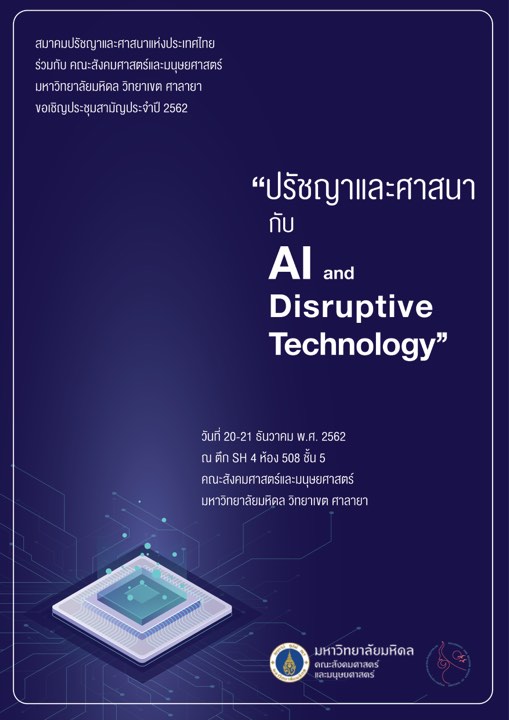
กำหนดการประชุมใหญ่สมาคมปรัชญา

กำหนดการงานประชุมสามุญประจำปีของสมาคมปรัชญาและศาสนาแห่งประเทศไทย

ในหัวข้อ “ปรัชญาและศาสนา กับ AI and Disruptive Technology”
โดย
สมาคมปรัชญาและศาสนาแห่งประเทศไทย ร่วมกับ คณะสังคมศาสตร์และมนุษยศาสตร์ มหาวิทยาลัยมหิดล วิทยาเขต ศาลายา
วันที่ 20-21 ธันวาคม พ.ศ. 2562 ตึก SH 4 ห้อง 508 ชั้น 5

วันศุกร์ที่ 20 ธันวาคม 2562

08.00-08.45 ลงทะเบียน
08.45-09.45 บรรยายพิเศษ Matthew Groh นักวิจัยสถาบัน MIT: “Learning to Detect AI Generated Media Manipulations”
09.45-10.00 รับประทานอาหารว่าง
10.00-11.00 เสวนา “AI กับชีวิต” ศ.ดร. โสรัจจ์ หงศลดารมภ์
11.00.-12.00 นำเสนอบทความ

Group AA- Friday 20th December 2019 (11.00 AM -12.00 PM)
11.00-11.30 – Prach Panchakunathorn “Risk-Taking and Justice”
11.30-12.00 – Jesada Buaban “AI Buddha: Savior in the Capital World”


12.00 – 13.00 พักรับประทานอาหารกลางวัน
13.00 – 14.00 ศาสนากับ disruption, อาจารย์ วรพงษ์ เจริญวงษ์(มหิดล), ผศ.ดร. วรยุทธ ศรีวรกุล(อัสสัมชัญ)
14.00 – 14.15 พักน้ำชา/กาแฟ อาหารว่าง
14.15 – 15.45 นำเสนอบทความ

Group BA- Friday 20th December 2019 (14.15 PM -15.45 PM) Room A
14.15-14.45 – อำนาจ ยอดทอง “ประเด็นจริยธรรมเกี่ยวกับเพศสัมพันธ์ในมุมมองพระพุทธศาสนา”
14.45-15.15 – มงคล เทียนประเทืองชัย “ปัญญาประดิษฐ์คิดและทำไม่เหมือนปัญญามนุษย์”
15.15-15.45 – สุมาลี มหณรงค์ชัย “ความหมายของศาสนาในยุคเทคโนโลยีรื้อทำลาย”

Group BB- Friday 20th December 2019 (14.15 PM -15.45 PM) Room B
14.15-14.45 – Hua Menglian “Big Data, E-Commerce and Deceptive Pricing”
14.45-15.15 – Li Wei and Xia Mingyue “The Ethical Problems of Virtual Eternity Technology and its Challenge to the Ethics of Chinese Deceased Culture”
15.15-15.45 – Zao Khamdai (Venerable) “B-technique”


15.45 – 16.45 ประชุมใหญ่ประจำปีสมาคม

วันเสาร์ที่ 21 ธันวาคม 2562
09.00-10.00 สนทนาเรื่อง Disruption ดร.จอมพล พิทักษ์สันตโยธิน กับ ดร. ปิยณัฐ ประถมวงษ์
10.00-10.15 อาหารว่าง
10.15-11.45 นำเสนอบทความ

Group CA- Saturday 21st December 2019 (10.15 AM -11.45 AM) Room A
10.15-10.45 – ชุตริณธรณ์ ฝั้นศิริ “การพัฒนาความสุขตามทัศนะของสมเด็จพระพุทธโฆษาจารย์ (ป. อ. ปยุตฺโต): ศึกษาเปรียบเทียบกับจิตวิทยาเชิงบวก”
10.45-11.15 – ธนีพร ภวภูตานนท์ ณ มหาสารคาม “การพัฒนาจริยธรรมด้วยเรื่องเล่าทางศาสนา: การจัดจริยศึกษาตามแนวทางแบบเรื่องเล่าด้วยทศชาติชาดกสำหรับนิสิตระดับปริญญาตรี”
11.15-11.45 – ไพเราะ มากเจริญ “ปัญญาประดิษฐ์ต้องรับผลของกรรมหรือไม่: มุมมองจากพุทธศาสนาเถรวาท”

Group CB- Saturday 21st December 2019 (10.15 AM -11.45 AM) Room B
10.15-10.45 – ไลลา หริ่มเพ็ง “จริยศาสตร์แห่งความอาทรและจริยศาสตร์แห่งความยุติธรรมในการจัดสรรซะกาต”
10.45-11.15 – อนุชา พูลสิน “ความเข้าใจเรื่องฮาลาลของผู้ขอการรับรองอาหารฮาลาลจากคณะกรรมการอิสลามประจำกรุงเทพมหานคร: การศึกษาทัศนะผู้ให้คำปรึกษาโรงงาน”
11.15-11.45 – สุพิชชา เพชรสังข์ “การใช้มังงะเพื่อสนับสนุนการเรียนรู้คำสอนทางพระพุทธศาสนา: “เดธโน้ต สมุดมรณะ” และกฎแห่งกรรม”


11.45 – 12.45 อาหารกลางวัน
12.45 – 13.45 เรื่อง บรรยายพิเศษ ศรชัย ฉัตรวิริยะชัย AI Arts: Blurrying the lines of Artists’ Agency or merely an emergence of re-contextualized industrial machines. ศิลปะกับปัญญาประดิษฐ์ : ตัวตนที่เลือนหายของศิลปินผู้สร้าง หรือ การผุดปรากฏของเครื่องจักรกลอุตสาหกรรมในบริบทที่แตกต่าง
13.45 – 14.00 อาหารว่าง
14.00 – 15.30 นำเสนอบทความ

Group DA- Saturday 21st December 2019 (14.00 PM -15.30 PM) Room A
14.00-14.30 – ธนัชชนม์ ธนาธิป-ปริพัฒน์ “การไม่สามารถแทนที่ของหุ่นยนต์นักบวชปัญญาประดิษฐ์: พิจารณาจากมุมมองพุทธศาสนา”
14.30-15.00 – อมรเทพฤทธิ์ สองสียนต์ และ ศักรินทร์ ณ น่าน “โลกที่ไม่ได้มีแค่มนุษย์: การเข้าใจรักโรแมนติกในสังคมดิจิตัลผ่านภาพยนตร์เรื่อง Her”
15.00-15.30 – รัฐพล เพชรบดี “ว่าด้วย มนุษย์ ชีวิต ความหมาย ความรัก และปัญญาประดิษฐ์ กับการสำรวจเชิงทดลองทางความคิด”

Group DB- Saturday 21st December 2019 (14.00 PM -15.30 PM) Room B
14.00-14.30 – เกลอ ประสิทธิเมกุล “เทคโนโลยีกำหนดความสุขอย่างนั้นหรือ?”
14.30-15.00 – เสาวณีย์ บุญคำ “การวิเคราะห์เชิงปรัชญาเรื่อง AI (การวินิจฉัย)ที่มีบทบาทต่อสังคมตามทรรศนะของปีเตอร์-พอล เฟอร์เบค”
14.00-14.30 – เสาวลักษณ์ บุญคำ “การวิเคราะห์เรื่องธรรมชาติของมนุษย์ในทรรศนะรูซโซเพื่อเสนอแก้ปัญหาอาชญากรรมในไทยเชิงประยุกต์”


15.30 ปิดประชุม

หมายเหตุ: ค่าลงทะเบียน สำหรับบุคคลทั่วไป 800 บาท สมาชิกสมาคมฯ 600 บาท นิสิตนักศึกษา 400 บาท
ค่าที่พักและค่าเดินทางเบิกได้ที่ต้นสังกัดตามหนังสือกระทรวงการคลังที่ กค ๐๔๐๙.๖ฝว.๙๕ ลงวันที่ ๒ ตุลาคม ๒๕๔๙ และเข้าร่วมอบรมโดยไม่ถือว่าเป็นวันลาเมื่อผู้บังคับบัญชาอนุญาตแล้ว

http://www.parst.or.th/

Categories
ethical issues ethics

Ethics of Science and Technology: Preparing Professionals for Ethical Science

Joint Chulalongkorn University –

American University of Sovereign Nations (AUSN)

Intensive Training Workshop on Ethics of Science and Technology: Preparing Professionals for Ethical Science

Chulalongkorn University, Bangkok, Thailand

8-10 January 2015

Agenda and Background

Convened by the Center for Ethics of Science and Technology, Chulalongkorn University; American University of Sovereign Nations (AUSN) and Eubios Ethics Institute.

The training will be led by Professor Darryl Macer, Director of the Institute of Indigenous Peoples and Global Studies, and of the Masters Program in Bioethics and Global Public Health (MBGPH), AUSN, USA and Professor Soraj Hongladarom, Professor of Philosophy and Director of the Center for Ethics of Science and Technology at Chulalongkorn University, and AUSN Visiting Professor of Ethics of Science and Technology and Philosophy.

There will be other professors and professionals from a range of fields and countries. There will be intensive bioethics training and mentoring on professional presentation, teaching and research skills, with participants invited to make improved presentations after intense training.

This training will count as 3 credit hours for the MBGPH degree, and one of three required residential Intensive Training Programs to graduate from the MBGPH or MPH programs.1 Participants can take it as a stand-alone professional development course as well, but we encourage all those involved in teaching bioethics to gather the Masters degree as well, which is offered as a combination of residential and online sessions around the world. This should increase your salary and job opportunities! AUSN will be offering tuition fee waivers for excellent trainees, for the Masters Program in Bioethics and Global Public Health (MBGPH). Participants are responsible for their own travel and accommodation and meals.

It is free, and it will be fun! – No registration fee for accepted applicants. Register with your background to Ms. Ananya Tritipthumrongchok, Manager, Eubios Ethics Institute, Email: ananya@eubios.info Tel. (+66) 081-870-5959

Draft Agenda

Thursday, 8 January 2015

Room 601/27, Maha Chakri Sirindhorn Building, Chulalongkorn University

8:30 Registration starts

9:00-12:00 lectures by Darryl and Soraj (covering all the topics on the list below during the conference*)

13:00-14:00 lunch in the ground floor cafeteria

14:00-18:00 lectures by Darryl and Soraj and Others including:

Introduction to the MBGPH and MPH combination hybrid programs of AUSN, Darryl Macer

Ethics, autism and special need kids education – Muhammad Rezki Achyana, Director, Putrakami Foundation; Founder ABA Batam, Batam, Riau Archipelago Province, Indonesia

Title to select from list – Prof, Chutatip Umajavani, Thammasat University, Thailand

Ethics, Technology and Climate Change:  Multiple Challenges with Undetermined Future Parameters, Mr, Leonard  Le Blanc ,  Thailand/USA (To confirm)

Title to confirm, Mr. Diwas Chaulagain, UNESCO Youth’s Club, Nepal

*Attention to Speakers:

You can choose your own topic, or select something close to the topics below which we are covering in the 3 day Intensive Course. Please send back your preferences and the precise title to Darryl, Darryl@eubios.info

Topics will include those included by this 3 credit course of AUSN:

1) Ethics and Philosophy of Science

2) History of science and technology

3) Nanotechnology ethics, Professor Soraj Hongladarom

4) Nanotechnology and environmental and health impacts, Professor Soraj Hongladarom

5) Information ethics and privacy, Professor Soraj Hongladarom

6) Artificial intelligence, the singularity, cyborgs, Professor Soraj Hongladarom(?)

7) Ethics and materials sciences

8) Engineering ethics

9) Disaster ethics

10) Professional responsibility for scientists

11) Use of science and technology in determining public health policies

12) Nuclear weapons technology

13) Open topics

14) The paradigms of science in different cultures

Friday, 9 January 2015

Room 601/27, Maha Chakri Sirindhorn Building, Chulalongkorn University

8:30 Registration starts

9:00-12:00 lectures by Darryl and Soraj (on topic list)

13:00-14:00 lunch in the ground floor cafeteria

14:00-18:00 lectures by Darryl and Soraj and Others

Saturday, 10 January 2015

Room 601/21, Maha Chakri Sirindhorn Building, Chulalongkorn University

8:30 Registration starts

9:00-12:00 lectures by Darryl and Soraj (on topic list)

13:00-14:00 lunch in the ground floor cafeteria

14:00-17:00 lectures by Darryl and Soraj and Others

End

Conference and Course Learning Objectives

1)   How to balance the benefits of science and technology versus the uncertainty of risks, and the precautionary principle.

2)  Ethical issues of labeling genetically modified food, and comparisons to other functional foods.

3) Illustrate dilemmas between use of different forms of energy technologies and preservation of the environment.

4) Information ethics and cyborgs, and artificial intelligence.

5) Nanoethics – overview potential effects of nanotechnology on relations between humans and with the environment.

6)  Engineering ethics and evolution of professional ethics.

7)  Analyze ethical situations that arise in health care, public health, pastoral care, patient advocacy, genetics, medical social work, medical research, environmental sciences and the life sciences.

8)  Identify ethical dilemmas through different lens, including those of gender lens, ability studies, and the perspectives of indigenous communities.

9) Create and scrutinize policies and practices in various settings.

Note on the 10th there will be travel immediately for those coming to Kaeng Krachan (please bring your bags to the conference in the morning, and inform Ananya so that we can make vehicle and accommodation reservations as needed)

Like to see Nature? There will also be a volunteer group going for outdoor training and additional credit in environmental health and ethics, to look after trees and medicinal herbs at the International Peace Park at Kaeng Krachan from 11-12 January if you like to be out of the City, in Trees, Nature and work for Peace. The trees in the peace park were planted by youth from around the world in the name of peace in 2012 and 2013. You can eat the bananas grown at the Park directly from the tree! Come to Thailand in the “cool” season of the year (it is only hot and dry…). We will finish with a night at the Ocean beach, where you may like to swim or reflect on what you have learnt.

Updates on Facebook: https://www.facebook.com/events/807586302631456/

Categories
conference

Report – “Ethics and Meaningful Broadband”

การประชุมเชิงปฏิบัติการ “จริยศาสตร์ ความเป็นอยู่ที่ดี และบรอดแบนด์ที่มีความหมาย”


เมื่อวันอังคารและพุธที่ ๑๖ กับ ๑๗ สิงหาคม พ.ศ. ๒๕๕๔ โครงการวิจัยเทคโนโลยีสารสนเทศเพื่อการเป็นอยู่ที่ดีได้จัดการประชุมเชิงปฏิบัติการนานาชาติเรื่อง “จริยศาสตร์ ความเป็นอยู่ที่ดี และบรอดแบนด์ที่มีความหมาย” (Ethics, Well-being and Meaningful Broadband) ที่ห้อง ๑๐๕ อาคารมหาจุฬาลงกรณ์ จุฬาลงกรณ์มหาวิทยาลัย ซึ่งเป็นส่วนหนึ่งของการดำเนินงานของโครงการ โดยมีวัตถุประสงค์เพื่อตอบคำถามสำคัญๆเกี่ยวกับแนวทางการใช้ประโยชน์สูงสุดจากเทคโนโลยีเพื่อให้เกิดความเป็นอยู่ที่ดี โครงการได้เรียนเชิญนักวิชาการที่มีชื่อเสียง โดยเฉพาะ Dr. Peter Hershock จาก East-West Center มหาวิทยาลัยฮาวาย ซึ่งกรุณารับเชิญมาเป็นผู้บรรยายหลักของการประชุม บทนี้จะเป็นรายงานการประชุมครั้งสำคัญนี้ ผลจากการประชุมนี้เป็นผลงานหลักอีกส่วนหนึ่งของงานวิจัยชิ้นนี้

หลักการและเหตุผล

การเสนอเครือข่ายบรอดแบนด์ในประเทศไทยที่ผ่านมาเต็มไปด้วยความท้าทายหลายประการ ซึ่งเป็นเรื่องของการกำกับดูแลและการต่อสู้ทางการเมือง กลุ่มต่างๆพยายามที่จะแย่งชิงผลประโยชน์อันมหาศาลที่มาจากเครือข่ายนี้ และแน่นอนว่าไม่มีใครอยากจะเป็นฝ่ายพ่ายแพ้ การต่อสู้นี้ทำให้เกิดภาวะชะงักงันซึ่งไม่ก่อประโยชน์ให้แก่ฝ่ายใดเลย อย่างไรก็ตามในเวลานี้ก็ยังพอมีความหวังอยู่บ้างจากการที่คณะกรรมการกิจการสื่อสารและโทรคมนาคมแห่งชาติ (กสทช.) ได้รับการสรรหาและจะได้รับการโปรดเกล้าฯอย่างเป็นทางการ คณะกรรมการ กสทช. มีอำนาจหน้าที่โดยตรงในการแก้ปัญหาภาวะชะงักงันนี้ เพื่อให้ประเทศสามารถก้าวไปข้างหน้าได้

อย่างไรก็ดี แม้เมื่อ กสทช. จะได้เริ่มทำงานในเวลาอันใกล้ แต่ก็มีความท้าทายชุดใหม่เกิดขึ้น อันเป็นเรื่องของผลสืบเนื่องจากการเสนอเครือข่ายบรอดแบนด์ให้แก่สังคม เมื่อประเทศมีโครงข่ายทางกายภาพ ความท้าทายใหม่ก็จะประกอบด้วยการหาแนวทางที่จะทำให้โครงข่ายนี้เป็นประโยชน์สูงสุดแก่ประชาชน เราได้นำเสนอแนวคิดเกี่ยวกับ “บรอดแบนด์ที่มีความหมาย” ซึ่งหมายถึงการที่โครงข่ายกายภาพจะตอบสนองความต้องการไม่เพียงแต่ด้านการเจริญเติบโตทางเศรษฐกิจเท่านั้น แต่ยังต้องตอบสนองต่อระบบคุณค่าและเป้าหมายของสังคมที่ไม่สามารถวัดได้โดยตรง คุณค่าและเป้าหมายดังกล่าวนี้เองที่ประกอบขึ้นเป็น “ความหมาย” ของชีวิตของประชาชน

ตัวอย่างของการมีความหมายนี้ก็ได้แก่การที่ประชาชนจะไม่เป็นเพียงแค่ฟันเฟืองตัวหนึ่งในระบบเศรษฐกิจยักษ์ใหญ่ แต่ยังคงรักษาเป้าหมายและทิศทางของการดำรงชีวิตของตนเองเอาไว้ ดังนั้นเนื้อหาของความท้าทายชุดใหม่นี้จึงได้แก่คำถามว่า บรอดแบนด์จะกลืนเข้าเป็นส่วนหนึ่งของวิถีชีวิตของประชาชนได้อย่างไร เพื่อมิให้ประชาชนกลายเป็นเพียงฟันเฟืองในจักรกลของโลกาภิวัตน์ บริโภคนิยมและระบบเศรษฐกิจเสรีนิยมใหม่? บรอดแบนด์จะเข้าไปเป็นส่วนหนึ่งและช่วยส่งเสริมระบบคุณค่า รวมทั้งศีลธรรมคุณธรรมของประชาชนได้อย่างไร?

คำถามเหล่านี้เป็นหลักการและเหตุผลของการประชุมเชิงปฏิบัติการนานาชาติ “จริยศาสตร์ การเป็นอยู่ที่ดีและบรอดแบนด์ที่มีความหมาย” (Ethics, Wellbeing and Meaningful Broadband) ซึ่งได้จัดขึ้นที่ห้อง ๑๐๕ อาคารมหาจุฬาลงกรณ์ จุฬาลงกรณ์มหาวิทยาลัย เมื่อวันที่ ๑๖ และ ๑๗ สิงหาคม พ.ศ. ๒๕๕๔ ที่ผ่านมา คณะผู้จัดการประชุมได้เรียนเชิญนักวิชาการผู้มีชื่อเสียงทั้งในและต่างประเทศ เพื่อมาช่วยกันระดมความคิดและค้นหาคำตอบของปัญหาดังกล่าว นอกจากนี้ในรายละเอียดการประชุมครั้งนี้มุ่งตอบปัญหาดังต่อไปนี้

๑. เราจะสร้างดรรชนีวัด “เศรษฐกิจพอเพียง” อย่างเป็นรูปธรรมได้อย่างไร? รัฐธรรมนูญแห่งราชอาณาจักรไทยกำหนดว่าการดำเนินนโยบายต่างๆต้องเป็นไปตามหลักเศรษฐกิจพอเพียงของพระบาทสมเด็จพระเจ้าอยู่หัว หลักการนี้ใกล้เคียงกับหลัก “ความสุขมวลรวมประชาชาติ” ของพระราชาธิบดีแห่งประเทศภูฏาน คำถามก็คือหลักการทั้งสองนี้จะแปลออกมาเป็นชุดของตัวชี้วัดและดรรชนีที่สามารถนำไปปฏิบัติจริงได้อย่างไร? คณะกรรมการ กสทช. ในฐานะผู้มีอำนาจกำกับดูแลกิจการโทรคมนาคม สามารถดำเนินการให้นโยบายบรอดแบนด์เป็นไปตามหลักเศรษฐกิจพอเพียงได้โดยตรง นโยบายเช่นการจัดสรรคลื่นความถี่ การกำหนัดอัตราภาษี สามารถเป็นไปตามหลักเศรษฐกิจพอเพียง และเป็นการดำเนินงานที่ประยุกต์ใช้หลักดังกล่าวในการบริหารกิจการสาธารณะของประเทศอย่างเป็นรูปธรรม คำถามก็คือ ในการดำเนินงานดังกล่าวนี้ จะต้องทำอย่างไรในรายละเอียดเพื่อให้เป็นไปตามหลักเศรษฐกิจพอเพียงจริงๆ? แนวทางหนึ่งที่ กสทช. สามารถทำได้คือบูรณาการระหว่างงานของ กสทช. เองกับหน่วยงานภาครัฐอื่นๆ เช่นกระทรวงศึกษาธิการ หรือสาธารณสุข เพื่อให้นโยบายการจัดสรรคลื่นความถี่ หรือการกำหนดอัตราภาษี สามารถก่อให้เกิดผลดีในด้านการศึกษา หรือสุขภาพของประชาชนคนไทยโดยรวม

๒. เราจะป้องกันไม่ให้เกิดความจำเป็นที่จะต้องมีการปิดกั้นข้อมูลบนอินเทอร์เน็ตได้อย่างไร? ปัญหาประการหนึ่งที่เกิดแก่ประเทศไทยซึ่งทำให้ประเทศไทยต้องตกเป็นเป้าของการวิพากษ์วิจารณ์ในระดับโลก ได้แก่การปิดกั้นข้อมูลข่าวสาร เช่นการบล๊อคเว็บไซต์ต่างๆ และการใช้กฎหมายอาญาข้อหาหมิ่นพระบรมเดชานุภาพอย่างพร่ำเพรื่อ นอกจากนี้ก็ยังมีปัญหาเกี่ยวกับเว็บลามกอนาจาร เว็บการพนัน ปัญหาทำนองเดียวกันนี้ก็เกิดขึ้นในประเทศอื่นๆในเอเซียด้วย เช่นในสิงคโปร์มีการปิดกั้นการวิพากษ์วิจารณ์รัฐบาลอย่างเข้มงวด ในจีนเป็นที่รู้กันว่ามีการปิดกั้นเสรีภาพในการแสดงออกในหลายๆด้าน การปิดกั้นการแสดงออกเช่นนี้เป็นตัวอย่างของ “การโยนเด็กไปพร้อมๆกับน้ำที่ใช้อาบ” ซึ่งหมายถึงการแก้ปัญหาที่ทำให้เกิดผลเสียมากกว่าผลดี เนื่องจากวิธีการในการแก้ปัญหานั้นทำให้กระทบต่อด้านอื่นๆของสังคมด้วย ทั้งนี้ก็เนื่องจากว่าการปิดกั้นข่าวสารแต่เพียงอย่างเดียว ทำให้การติดต่อสื่อสารบนอินเทอร์เน็ตชะงักงัน การที่อินเทอร์เน็ตจะเป็นประโยชน์ได้ก็จะต้องมีการไหลเวียนของข้อมูลข่าวสารอย่างเสรี การปิดกั้นก็เท่ากับว่าประเทศที่ปิดนั้น ปิดตัวเองออกจากประโยชน์ด้านต่างๆที่จะได้จากการมีส่วนร่วมในโลกของอินเทอร์เน็ต ดังนั้นจึงจำเป็นต้องหาวิธีที่จะป้องกันไม่ให้เกิดความจำเป็นที่จะต้องมีการปิดกั้นการไหลเวียนของข้อมูลข่าวสารตั้งแต่แรก

อย่างไรก็ตาม เราอาจคาดได้ว่าหากไม่มีการดำเนินการใดๆ แนวโน้มที่จะมีการปิดกั้นจะมีมากขึ้น เว้นแต่ว่าจะมี “ระบบนิเวศบรอดแบนด์แห่งชาติ” ที่ความหมายแก่ชาติและประชาชนจริงๆ ความจำเป็นของกลุ่มประชากรที่มีความเสื่ยงสูง เช่นกลุ่มคนยากจน ด้อยการศึกษา หรือเด็กและเยาวชน จะต้องได้รับการตอบสนอง คำถามสำคัญๆเกี่ยวกับด้านนี้ก็มีเช่น เราจะออกแบบและมีมาตรการกำกับดูแลอย่างไรเพื่อให้มีเทคโนโลยีที่รวมเอาหลักการทางศีลธรรมจริยธรรมเข้าไปอยู่ในผลผลิตของเทคโนโลยีนั้นๆด้วย? เราจะเรียนรู้จากความพยายามในการพัฒนา “ดรรชนีคุณภาพชีวิต” เช่นที่มีอยู่ในแนวคิดความสุขมวลรวมประชาชาติของภูฏานอย่างไร เพื่อให้มีมาตรการที่เป็นรูปธรรมที่ผู้วางนโยบายจะนำไปใช้ เพื่อหันเหทิศทางของการพัฒนาเทคโนโลยีให้เป็นไปในทางที่ต้องการ?

๓. เสนอแนวคิดใหม่ๆเกี่ยวกับ “จริยธรรมของสื่อ” ในยุคบรอดแบนด์ คำถามก็มีเช่น ยุทธศาสตร์ด้านจริยธรรมสื่อมีประวัติผลงานอะไรบ้างที่ยังผลให้เกิดการจำกัดขอบเขตของความเสียหายที่เกิดจากโทรทัศน์ และก่อให้เกิดการทำตามหลักการทางจริยธรรมโดยสมัครใจ? มีอะไรบ้างที่ทำได้หรือทำไม่ได้เกี่ยวกับการมีอิทธิพลต่อพฤติกรรมของผู้ใช้สื่อเป็นจำนวนมาก เช่นเด็กและเยาชน? มีอุปสรรคอะไรบ้างที่ทำให้การปฏิบัติตามแนวยุทธศาสตร์ด้านจริยธรรมของสื่อไม่ประสบความสำเร็จ เช่นไม่สามารถลดปริมาณการรับสื่อที่ไม่เหมาะสมของเยาวชนลงไปได้? ในยุคของบรอดแบนด์จะมีการรวมตัวกันของสื่อประเภทต่างๆ ทำให้อิทธิพลและพลังของสื่อเพิ่มขึ้นเป็นอย่างมาก งานด้านจริยธรรมสื่อจะมีการเปลี่ยนแปลงอย่างไรบ้างเพื่อให้ตอบสนองกับความท้าทายนี้ได้? ตัวอย่างของประเทศเกาหลีใต้ ซึ่งมีปัญหาเด็กติดเกมอย่างหนักจนเกิดผลกระทบเป็นวงกว้าง น่าจะเป็นบทเรียนที่ดีที่เราจะป้องกันไม่ให้เกิดเหตุการณ์แบบเดียวกันในประเทศไทย การที่เราจะรวมเอาแนวคิดด้านจริยธรรมเช่นนี้ให้เข้ากับการวางนโยบายการกำกับดูแลสื่อควรจะทำอย่างไร?

๔. ทำนายผลกระทบทางจริยธรรมของบรอดแบนด์ คำถามประกอบด้วย วิธีการที่ดีที่สุดในการสร้างภาพฉายสู่อนาคตเพื่อช่วยให้มองเห็นผลของทางเลือกต่างๆเกี่ยวกับผลกระทบทางจริยธรรมของบรอดแบนด์เป็นอย่างไร? สังคมที่ “มีความเป็นอยู่ที่ดี” จะต้องเป็นอย่างไรและบรอดแบนด์จะมีบทบาทในสังคมนี้อย่างไร? บรอดแบนด์จะก่อให้เกิดสังคมที่มีความเป็นอยู่ที่ดีได้อย่างไร? ผลกระทบทางจริยธรรมของบรอดแบนด์ในประเทศยากจนที่กำลังพัฒนา จะเหมือนหรือแตกต่างกับผลกระทบแบบเดียวกันในประเทศพัฒนาแล้วอย่างไรบ้าง?

๕. นิยัตินิยมทางเทคโนโลยี หรือเทคโนโลยีกำหนดโดยมนุษย์? ปัญหาทางทฤษฎีที่เป็นพื้นฐานของการคิดอภิปรายเกียวกับเรื่องเหล่านี้ทั้งหมด ได้แก่ทรรศนะทางปรัชญาของทรรศนะที่ตรงข้ามกัน ได้แก่นิยัตินิยมทางเทคโนโลยี ซึ่งเชื่อว่าเทคโนโลยีกำหนดทิศทางของสังคมและประวัติศาสตร์ กับทรรศนะที่เชื่อว่าเทคโนโลยีเป็นกลางและโอนอ่อนได้ตามความต้องการของมนุษย์และสังคม อย่างที่ได้เสนอไปแล้วในงานวิจัยนี้ ทางเลือกที่น่าจะเป็นมากที่สุดได้แก่ทรรศนะที่อยู่ระหว่างกลางของสองทรรศนะนี้

กำหนดการประชุม และรายงานการประชุมโดยสรุป

August 16, 2011

11.45 Lunch and Registration

13.00 “The Second Wireless Revolution: Bringing Meaningful Broadband to the Next Two Billion,” Craig W. Smith

การบรรยายของ Dr. Craig Smith ซึ่งเป็นผู้วิจัยหลักของโครงการ Meaningful Broadband ประกอบด้วยการเสนอแนวคิดหลักของโครงการ โดยเฉพาะอย่างยิ่งประเด็นว่าเหตุใดจึงต้องมีการพยายามทำให้เทคโนโลยีสื่อสาร “บรอดแบนด์” ซึ่งได้แก่การติดต่อทางอินเทอร์เน็ตผ่านระบบคลื่นวิทยุไร้สาย โดยมีอุปกรณ์ที่มีขนาดเล็กพกพาสะดวก (ในปัจจุบันได้แก่โทรศัพท์ที่เรียกว่า “smart phone” เช่น iPhone และโทรศัพท์ที่ทำงานในระบบปฏิบัติการ Android รวมทั้งคอมพิวเตอร์แท็บเบล็ต เช่น iPad และคอมพิวเตอร์ในระบบ Android เช่นเดียวกัน) เป็นอุปกรณ์หลัก เหตุผลสำคัญที่ต้องมีการขยายโครงข่ายของบรอดแบนด์ก็คือว่า การทำเช่นนี้จะเป็นการนำพาผู้ที่อยู่ใน “ระหว่างกลางของปิระมิด” หรือผู้ที่มีรายได้ปานกลาง ไม่ถึงกับเป็นคนยากจน และก็ยังไม่นับเป็นคนชั้นกลางระดับบนที่ในปัจจุบันกำลังใช้อุปกรณ์เหล่านี้อยู่แล้ว ให้เข้ามาใช้ประโยชน์จากเทคโนโลยีดังกล่าว ผลที่เกิดขึ้นจะมีสูงมากทั้งในด้านของการพัฒนาทางเศรษฐกิจและการพัฒนาปัจจัยทางสังคมด้านอื่นๆ เช่นการศึกษา วัฒนธรรม และการสาธารณสุข Dr. Smith เป็นเจ้าของวลี “Meaningful Broadband” ซึ่งหมายถึงการใช้งานเทคโนโลยีที่มุ่งไปที่ระบบคุณค่าและคุณธรรมจริยธรรมของสังคม นอกเหนือไปจากเพียงแค่การสร้างโครงข่ายการสื่อสารทางกายภาพเท่านั้น การขยายการเข้าถึงโครงข่ายบรอดแบนด์จะทำให้ผู้ที่อยู่ในตอนกลางของปิระมิด ซึ่งก็ได้แก่ประชากรส่วนใหญ่ของสังคม ได้กลายเป็นจักรกลหลักในการขยายอัตราการเจริญเติบโตทางเศรษฐกิจของประเทศ ทั้งในแง่ของการเป็นผู้ผลิตสร้างรายได้ และในแง่ของการเป็นผู้บริโภคหรือเป็นตลาดให้แก่ผลิตผลต่างๆ อันจะเป็นการสร้างตลาดภายในประเทศ ซึ่งเป็นปัจจัยสำคัญในการแก้ปัญหาภาวะผันผวนที่เกิดขึ้นในระบบเศรษฐกิจโลก ในการบรรยายนี้ Dr. Smith ก็ได้เสนอแนวคิดหลักของโครงการ ได้แก่การทำให้บรอดแบนด์มีลักษณะที่ “มีความหมาย” ในสามลักษณะ ได้แก่การมีราคาไม่แพง คนทั่วไปสามารถซื้อมาใช้ได้ การใช้งานง่าย และการให้พลังอำนาจแก่ผู้ใช้ ซึ่งหมายถึงการที่ผู้ใช้สามารถบรรลุเป้าประสงค์และระบบคุณค่าต่างๆของผู้ใช้เองได้อย่างมีประสิทธิภาพมากขึ้นด้วยการใช้งานเทคโนโลยี

14.00 “Content Regulations in the Broadband Era: Incentives and Disincentives Based Approach to Content Regulations,” by Akarapon Kongchanagul

การบรรยายถัดมาเป็นของ ดร. อัครพล คงชนะกูลจากสำนักงานคณะกรรมการกิจการโทรทัศน์ กิจการกระจายเสียงและโทรคมนาคมแห่งชาติ ดร. อัครพลเป็นนักเศรษฐศาสตร์ และได้เสนอแนวคิดที่น่าสนใจอย่างยิ่งเกี่ยวกับการกำกับดูแลเนื้อหาของอินเทอร์เน็ต เนื่องจากมีข้อโต้แย้งเป็นอันมากเกี่ยวกับว่าเนื้อหาแบบใดเหมาะสมหรือไม่เหมาะสม ซึ่งมองว่าเป็นเรื่องที่ไม่เป็นรูปธรรมและไม่อาจหาข้อยุติได้ ดร. อัครพลจึงเสนอแนวทางในการกำกับดูแลเนื้อหาตามหลักของเศรษฐศาสตร์ กล่าวคือใช้แนวทางด้านภาษีมาเป็นแรงจูงใจ กล่าวคือหากเว็บไซต์ใดเสนอเนื้อหาที่ผู้กำกับดูแลเห็นว่าไม่ควรจะให้เผยแพร่มากเกินไป ก็จะเก็บภาษีผู้จัดทำเว็บไซต์ในอัตราที่มากกว่าปกติ แต่หากผู้กำกับดูแลเห็นว่าเว็บไซต์ใดมีเนื้อหาที่ควรแก่การเผยแพร่ ก็จะมีมาตรการลดภาษี หรือแม้แต่สนับสนุนทุนให้จัดทำเว็บนั้นๆต่อไป อย่างไรก็ตามแนวคิดนี้ตั้งอยู่บนพื้นฐานที่ว่าหากเว็บใดมีเนื้อหาที่ขัดต่อกฎหมายโดยตรง ก็ต้องมีมาตรการจัดการตามกฎหมายอย่างเข้มงวด เว็บที่ไม่ได้รับการส่งเสริมทางภาษี หรือเว็บที่ถูกเก็บภาษีเพิ่ม จะต้องมีเนื้อหาที่ไม่ขัดกับกฎหมายเท่านั้น ข้อเสนอนี้ของ ดร. อัครพลก่อให้เกิดการอภิปรายอย่างกว้างขวางในที่ประชุม ประเด็นก็คือเราจะแน่ใจได้อย่างไรว่ามาตรการทางกฎหมายที่มีอยู่ มีความยุติธรรมจริงๆ ไม่ใช่เป็นกฎหมายที่ออกมาเพื่อปราบปรามฝ่ายตรงข้ามทางการเมืองที่ไม่เห็นด้วยกับผู้มีอำนาจ ประเด็นนี้อยู่นอกขอบข่ายของการบรรยายนี้ แต่ก็เป็นประเด็นสำคัญที่ไม่อาจหลีกเลี่ยงได้

14.45 “The Seven Habits of Highly Meaningful Broadband,” Arthit Suriyawongkul

การบรรยายต่อไปเป็นของคุณอาทิตย์ สุริยวงศ์กุล ซึ่งเป็นนักศึกษาระดับปริญญาโทที่มหาวิทยาลัยธรรมศาสตร์ เรื่องเกี่ยวกับเงื่อนไขเจ็ดประการของบรอดแบนด์ที่ประสบความสำเร็จ เงื่อนไขเหล่านี้ได้แก่ ๑. เศรษฐกิจกับสังคม ๒. การเมือง ๓. เทคโนโลยี–สื่อ ๔. การออกแบบหน้าจอ (เชื่อมมนุษย์กับอุปกรณ์) ๕. การออกแบบข้อมูล (ช่วยมนุษย์ตัดสินใจ) ๖. มาตรฐาน และ ๗. วัฒนธรรม สองประเด็นแรกค่อนข้างชัดเจนว่ามีบทบาทในการที่เทคโนโลยีจะประสบความสำเร็จได้อย่างไร ปัจจัยที่สามได้แก่เทคโนโลยีกับสื่อ หมายถึงระดับของการพัฒนาเทคโนโลยีเองว่ามีความสามารถในการแก้ปัญหาหรือไม่ หากเทคโนโลยีไม่เหมาะสมก็เป็นการยากที่จะให้เทคโนโลยีนั้นๆแก้ปัญหาตามจุดประสงค์ได้ เรื่องโครงข่ายกายภาพของสื่อก็เช่นเดียวกัน แต่อย่างไรก็ตามแม้เรื่องทางกายภาพเหล่านี้จะจำเป็น แต่ก็ไม่ใช่ทั้งหมดของการทำให้เทคโนโลยีบรอดแบนด์มีความหมายขึ้นมาได้จริงๆ ปัจจัยต่อไปได้แก่เรื่องการออกแบบหน้าจอหรือการทำให้มนุษย์เชื่อมต่อกับคอมพิวเตอร์ได้อย่างกลมกลืน หัวข้อนี้สำคัญมากและเป็นเนื้อหาของวิชาการแขนงที่เรียกว่า human-computer interaction ซึ่งพยายามตอบโจทย์ว่าจะทำให้คอมพิวเตอร์กับมนุษย์ติดต่อสื่อสารกันได้อย่างไรให้กลมกลืนกันที่สุด การออกแบบหน้าจอของคอมพิวเตอร์สมัยใหม่ ที่มีการใช้เมาส์ร่วมกับการสร้างภาพไอคอนบนจอล้วนเป็นผลงานของการคิดค้นเรื่องการติดต่อกันระหว่างมนุษย์กับคอมพิวเตอร์ทั้งสิ้น เงื่อนไขประการต่อไปได้แก่การออกแบบข้อมูลที่ช่วยให้มนุษย์ตัดสินใจ หมายถึงการที่เทคโนโลยีสามารถช่วยให้ผู้ใช้เข้าใจได้ง่ายว่าจะหันเหไปทิศทางไหร เทคโนโลยีที่จะประสบความสำเร็จต้องมีสิ่งที่ทำงานเป็น “ป้ายบอกทาง” เพื่อให้ผู้ใช้ไม่หลงวนเวียนอยู่ในการทำงานของเทคโนโลยีนั้น เงื่อนไขประการต่อไปได้แก่เรื่องมาตรฐาน ซึ่งเป็นเรื่องสำคัญมาก มาตรฐานได้แก่การกำหนดกรอบการทำงานร่วมกันระหว่างฝ่ายต่างๆหรือกลุ่มต่างๆ เพื่อให้ข้อมูลสามารถถ่ายเทไหลเวียนกันได้อย่างสะดวก ในอดีตผู้ใช้คอมพิวเตอร์มีปัญหาในการถ่ายโอนข้อมูลระหว่างคอมพิวเตอร์ระบบพีซีที่ใช้กันทั่วไป กับคอมพิวเตอร์แมคของบริษัทแอปเปิล ซึ่งใช้มาตรฐานในการแสดงผลตัวอักษรภาษาไทยไม่เหมือนกัน ปัญหานี้ทำให้การใช้งานเครื่องแมคเป็นไปได้อย่างเชื่องช้า แต่เมื่อบริษัทแอปเปิลเปลี่ยนระบบปฏิบัติการมาเป็น Mac OS X ซึ่งใช้มาตรฐานเดียวกันกับคอมพิวเตอร์ระบบอื่นๆในการแสดงภาษาไทย เครื่องแมคก็เป็นที่นิยมมากขึ้นเรื่อยๆจนถึงปัจจุบัน เงื่อนไขประการสุดท้ายอาจเรียกได้ว่าเป็นสิ่งที่สำคัญที่สุด วัฒนธรรมไม่ได้หมายความเพียงแค่ศิลปะ ดนตรีหรือวรรณคดีเท่านั้น แต่รวมไปถึงการทำงาน การคิด การพูดการเขียน หรือทั้งหมดที่เป็นการแสดงออกของกลุ่มชน ดังนั้นหากวัฒนธรรมไม่สอดคล้องกับการทำงานของเทคโนโลยี หรือการทำงานของเทคโนโลยีมีรูปแบบทางวัฒนธรรมที่ไม่สอดคล้องกับวัฒนธรรมของผู้ใช้ ก็ยากที่เทคโนโลยีจะประสบความสำเร็จตามที่มุ่งหวังไว้ได้

15.30 Break

15.45 “The Anonymous Group: A Look at Online Rebel,” Poomjit Siriwongprasert

การบรรยายต่อไปเป็นของคุณภูมิจิต สิรวงศ์ประเสริฐเกี่ยวกับกลุ่มแฮคเกอร์ชื่อดังคือ Anonymous Group ลักษณะของกลุ่มนี้คือจะคอยดูว่าหน่วยงานใดของรัฐที่ทำการที่ขัดต่อหลักความถูกต้องหรือความยุติธรรม แล้วก็จะเข้าไปแฮคเว็บไซต์ของหน่วยงานเหล่านั้น เพื่อขัดขวางการทำงานดังกล่าว จึงอาจกล่าวได้ว่ากลุ่ม Anonymous นี้ทำตัวเหมือนกับกลุ่มนักต่อสู้หรือนักกิจกรรมที่มุ่งขัดขวางผลประโยชน์ของหน่วยงานภาครัฐที่เป็นอันตรายต่อสาธารณะ หรือเป็นหน่วยงานที่มุ่งทำงานเพื่อตนเองแต่ไม่ได้ทำเพื่อประโยชน์ของประชาชนอย่างแท้จริง คุณภูมิจิตได้เล่าถึงประวัติความเป็นมาของกลุ่มนี้ และผลงานที่กลุ่มนี้ได้ทำลงไปซึ่งมีค่อนข้างมาก การนำเสนอของคุณภูมิจิตก่อให้เกิดการอภิปรายอย่างกว้างขวาง ประเด็นที่ถกเถียงกันคือว่าการกระทำของกลุ่มแฮคเกอร์อย่าง Anonymous นี้ถูกต้องหรือไม่ ในแง่หนึ่งการกระทำนี้ผิดกฎหมายอย่างชัดเจน เพราะกฎหมายหลายๆประเทศได้ห้ามการเจาะระบบเครือข่ายโดยไม่ได้รับอนุญาตหรือการ “แฮค” นี้ไว้ แต่เรื่องที่เถียงกันก็คือว่า การทำผิดกฎหมายนี้เป็นการกระทำที่ถูกต้องหรือไม่ คำถามอาจฟังดูแปลกๆสำหรับบางคน แต่ก็มีหลายกรณีในประวัติศาสตร์ที่การทำผิดกฎหมายเป็นการกระทำที่ถูกต้อง เพราะกฎหมายนั้นขัดต่อความถูกต้องชอบธรรม หรือเป็นกฎหมายที่ออกโดยผู้มีอำนาจที่ใช้อำนาจตามอำเภอใจเพื่อประโยชน์ส่วนตนไม่ใช่ส่วนรวม หรือเพราะการจงใจฝ่าฝืนกฎหมายเป็นการแสดงออกว่า รัฐบาลที่เป็นผู้มีอำนาจใช้กฎหมายนั้นไม่มีความชอบธรรมในการบริหารประเทศอีกต่อไป ตามมุมมองในแง่นี้การกระทำของกลุ่ม Anonymous แม้จะผิดกฎหมายแต่ก็ถูกต้อง เพราะเป็นการเปิดโปงความไม่ชอบธรรมในการดำรงอยู่ของรัฐบาล จุดนี้เองที่ทำให้ที่ประชุมถกเถียงกันมาก เพราะจะรู้ได้อย่างไรว่าเมื่อใดรัฐบาลหมดความชอบธรรมในการดำรงอยู่แล้ว

16.30 “Give Them the Tools, Get Out of the Way: the Liberisation of Communication and its Consequences,” Nares Damrongchai

การบรรยายต่อไปเป็นการบรรยายโดย ดร. นเรศ ดำรงชัยจากศูนย์คาดการณ์เทคโนโลยี APEC Center of Technology Foresight เนื้อหาเป็นการพิจารณาถึงการใช้ประโยชน์จากเทคโนโลยีสารสนเทศในด้านต่างๆ ที่น่าสนใจได้แก่เรื่องการใช้ทวิตเตอร์เพื่อช่วยเหลือผู้ประสบภัยจากเหตุการณ์แผ่นดินไหวและสึนามิในญี่ปุ่นเมื่อเดือนมีนาคมที่ผ่านมา โดยมีทวิตเตอร์ @team_nakagawa ซึ่งเป็นทวิตเตอร์ของอาจารย์ทางฟิสิกส์ที่มหาวิทยาลัยโตเกียว ที่ให้ความรู้แก่ประชาชน ตลอดจนเป็นฝ่ายประสานงานด้านข้อมูลต่างๆเกี่ยวกับกัมมันตภาพรังสีและการบำบัดรักษาผลกระทบจากกัมมันตภาพรังสีที่เกิดจากการระเบิดของโรงไฟฟ้านิวเคลียร์ที่ฟูกุชิมา ดร. นเรศได้ชี้ให้เห็นถึงประโยชน์ด้านต่างๆของเทคโนโลยีสารสนเทศ แต่ก็พูดถึงผลกระทบทางด้านลบของเทคโนโลยีนี้ด้วย


August 17, 2011

9.00 Keynote Lecture, “Ironies of Interdependence: Some Reflections on ICT and Equity in Global Context,” Peter Hershock, East-West Center, USA

การบรรยาย keynote ของประชุมนี้ได้แก่เรื่อง “Ironies of Interdependence” โดย Dr. Peter Hershock จากศูนย์ East-West Center มหาวิทยาลัยฮาวาย สหรัฐอเมริกา Dr. Hershock เคยมาประเทศไทยหลายครั้งแล้ว ครั้งสุดท้ายก็ได้มาร่วมงานประชุมนานาชาติ GNH Conference ที่จุฬาลงกรณ์มหาวิทยาลัย เมื่อปี พ.ศ. ๒๕๕๐ ที่ผ่านมา ในครั้งนี้ Dr. Hershock ได้รับคำเชิญมาเป็นผู้บรรยายหลักหรือ Keynote speaker ในการประชุมเชิงปฏิบัติการเรื่องบรอดแบนด์ที่มีความหมายนี้ และก็ได้เสนอแนวคิดที่เป็นประโยชน์แก่การคิดเกี่ยวกับนโยบายและแนวทางการดำเนินงานด้านเทคโนโลยีเพื่อสังคมไว้หลายประการ แนวคิดหลักที่ Dr. Hershock ได้นำเสนอในการประชุมได้แก่ว่า เทคโนโลยีสารสนเทศควรจะก่อให้เกิดประโยชน์แก่ประชาชนอย่างแท้จริง การบรรยายเริ่มจากแนวคิดเรื่อง interdependence หรืออิทัปปัจจยตา ซึ่งเป็นแนวคิดหลักในพระพุทธศาสนา แนวคิดนี้ทำให้การลดทอนเทคโนโลยีลงไปเป็นเพียงเครื่องมือเป็นแนวคิดที่ไม่ถูกต้อง เพราะเทคโนโลยีจำเป็นแฝงไว้ด้วยระบบคุณค่าเสมอ นอกจากนี้แนวคิดเกี่ยวกับกรรมในพระพุทธศาสนายังทำให้ตระหนักว่า การปลดปล่อยออกจากทุกข์นั้นจำเป็นต้องอิงอาศัยกระบวนการที่ประกอบไปด้วยความสัมพันธ์ซึ่งกันและกันของทุกสิ่งทุกอย่าง ในทางปฏิบัติเรื่องนี้หมายความว่า การสร้าง “สังคมเป็นอยู่ที่ดี” นั้นเทคโนโลยีเป็นเพียงปัจจัยเดียว เทคโนโลยีนั้นเองจำเป็นต้องอิงอาศัยกับปัจจัยอื่นๆและทำงานด้วยกันอย่างเป็นระบบ เพื่อให้สังคมที่ว่านี้เกิดขึ้นได้จริง การแก้ปัญหาเรื่อง “ช่องว่างดิจิตัล” ดูเผินๆแล้วจะเป็นเรื่องของปัญหาทางเทคนิคล้วนๆ ที่สามารถแก้ได้ง่ายๆด้วยวิธีการทางเทคนิค เช่นขยายโครงข่ายทางกายภาพและลดราคาอุปกรณ์เทคโนโลยี แต่ในความจริงแล้ว เนื่องจากทุกอย่างสัมพันธ์เกี่ยวเนื่องกันทั้งหมด การทำเช่นนั้นจึงไม่อาจก่อให้เกิดผลที่ต้องการได้ เนื่องจากเทคโนโลยีเองก็สัมพันธ์เป็นส่วนหนึ่งกับระบบสังคม การแก้ปัญหาช่องว่างดิจิตัลจึงไม่อาจทำได้หากไม่พิจารณาประเด็นที่แวดล้อมอยู่ เช่นความเป็นธรรมในสังคม ความยุติธรรมและความโปร่งใสในระบบการเมือง เป็นต้น Dr. Hershock ได้วิพากษ์แนวทางการใช้เทคโนโลยีในปัจจุบัน ที่เชื่อว่าการมีเสรีภาพในการเลือกเป็นสิ่งดี แต่เมื่อวิเคราะห์ไปจริงๆการมีเสรีภาพในการเลือกนั้น อาจเป็นเพียงภาพลวงตา เนื่องจากสิ่งที่จะเลือกนั้นโดยเนื้อแท้แล้วไม่มีอะไรต่างกัน และที่สำคัญคือทางเลือกที่จะทำให้การเลือกมีความหมายขึ้นมาจริงๆ กลับไม่ได้รับการเหลียวแล คนในโลกสมัยใหม่อาจมีทางเลือกว่าจะดื่มโค้กหรือเป๊ปซี่ แต่กระแสของสังคมสมัยใหม่ไม่ได้เสนอว่ายังมีทางเลือกอื่นที่ไม่ใช่ทั้งโค้กและเป๊ปซี่ แต่กินน้ำเปล่าแทน ทางเลือกนี้ไม่ได้รับการเหลียวแลเพราะการกินน้ำเปล่าไม่ได้ทำให้บริษัทใดร่ำรวยขึ้นมา (เว้นแต่จะเป็นการกิน “น้ำแร่” หรือ “น้ำบรรจุขวด” ซึ่งในแง่นั้นก็เข้าไปอยู่ในระบบทางเลือกที่ไม่มีการเลือกเหมือนกัน) ในกรณีของเทคโนโลยีสารสนเทศ จะดูเหมือนว่าผู้ใช้มีทางเลือกมากมาย แต่ก็มีคำถามว่าเป็นทางเลือกที่แท้จริงหรือไม่ นอกจากนี้ยังมีการวิพากษ์เทคโนโลยีสารสนเทศในแง่ของอำนาจและการควบคุม โดยบริษัทที่เป็นเจ้าของเทคโนโลยีจะมีอำนาจควบคุมผู้ใช้ได้เนื่องจากสามารถออกแบบเว็บไซต์หรือเทคโนโลยีของตน เพื่อให้ผู้ใช้ใช้งานในรูปแบบที่ตนเองต้องการ ผู้ใช้เองก็จะคิดว่าตนเองมีการควบคุมอย่างเต็มที่ เพราะมีทางเลือกต่างๆเปิดกว้างอยู่ในอินเทอร์เน็ต แต่แท้จริงแล้วทางเลือกเหล่านั้นเป็นเพียงภาพลวงตาที่มีแต่จะทำให้ผู้ใช้ติดกับอยู่ในบ่วงของอินเทอร์เน็ตอยู่เรื่อยๆ จนถอนตัวไม่ขึ้น คิดไปว่าอินเทอร์เน็ตเป็นเหมือนกับ “สภาพแวดล้อม” ที่ขาดไม่ได้ แนวคิดหนึ่งในการคิดเกี่ยวกับนโยบายเทคโนโลยีสารสนเทศกับการพัฒนาก็คือว่า ควรให้มีการเข้าถึงอย่างสากล หรือพูดอีกอย่างคือให้ทุกคนมีโอกาสในการเข้าถึงเทคโนโลยี เรื่องนี้ฟังดูเหมือนกับว่าเป็นเรื่องดี แต่ในความเป็นจริงการเข้าถึงที่เป็นสากลนั้นไม่จำเป็นว่าจะต้องตามมาด้วยความเสมอภาคหรือความเป็นธรรมในสังคมเสมอไป

เมื่อเป็นเช่นนี้ข้อเสนอของ Dr. Hershock ก็คือเราควรใช้หลักของพระพุทธศาสนาเกี่ยวกับการกระทำที่เป็นกุศลและที่เป็นอกุศล เพื่อเป็นพื้นฐานในการคิดและดำเนินนโยบาย การกระทำที่เป็นกุศลได้แก่การกระทำที่เป็นประโยชน์แก่ตนเองและผู้อื่น คำถามสำคัญก็คือว่า เราจะต้องทำอย่างไรเพื่อหลีกเลี่ยงกรรมอันเป็นอกุศล ได้แก่การทำให้เทคโนโลยีสารสนเทศเป็นเครื่องมือในการบังคับและควบคุม และเพื่อประกอบกรรมอันเป็นกุศล ได้แก่การทำให้เทคโนโลยีนี้เป็นเครื่องมือในการสร้างสรรค์ซึ่งกันและกัน คำตอบอยู่ที่ว่ากุศลกรรมที่เราอยากให้เกิดขึ้นนี้ จะต้องเกิดขึ้นควบคู่กับการเปลี่ยนแปลงในระดับกว้างของสังคม ที่เราทุกคนต้องมีส่วนร่วมในการทำให้เกิดขึ้น ดังนั้นเราไม่สามารถเปลี่ยนแปลงได้แก่เรื่องทางเทคนิคของเทคโนโลยีเท่านั้น แต่ต้องเปลี่ยนโครงสร้างระดับบนของสังคม ได้แก่โครงสร้างทางการเมือง เศรษฐกิจ สังคมและวัฒนธรรม เพื่อให้การดำเนินนโยบายเทคโนโลยีเพื่อสังคม สามารถสร้างสังคมที่ผู้คนมี “ความเป็นอยู่ที่ดี” อย่างแท้จริง

10.00 “Toward a Well-being Society Scenario,” Hans van Willenswaard

ต่อไปเป็นการบรรยายของ Mr. Hans van Willenswaard เกี่ยวกับโครงการจำลองสถานการณ์สังคมเป็นอยู่ที่ดี ซึ่งงานวิจัยนี้เป็นส่วนหนึ่งของโครงการนี้ เนื่องจากโครงการนี้มีพูดถึงอยู่ในส่วนอื่นๆซึ่งอยู่ในรายงานใหญ่ของโครงการนี้แล้ว จึงจะไม่รายงาน ณ ที่นี้

10.45 Break

11.00 “From Veblen to Zuckerberg: Past, Present, and Future of Techno-Determinism in Thailand,” Pun-arj Chairatana

การบรรยายต่อมาเป็นเรื่องเกี่ยวกับนิยัตินิยมทางเทคโนโลยี โดย ดร. พันธุ์อาจ ชัยรัตน์ จาก บริษัทโนวิสเคปคอนซัลติงค์กรุ๊ปจำกัด ดร. พันธุ์อาจเล่าถึงประวัติความเป็นมาของแนวคิดแบบนิยัตินิยมเทคโนโลยีที่เริ่มจากนักเศรษฐศาสตร์ Thorsten Veblen และ Karl Marx จากนั้นก็เป็นการเสนอความคิดเห็นเกี่ยวกับประเทศไทยว่าตกอยู่ภายใต้นิยัตินิยมนี้หรือไม่ คำตอบก็คือว่าดูเหมือนว่าเป็นเช่นนั้น ดร. พันธุ์อาจกล่าวว่าคนไทยโดยทั่วไปอยู่ภายใต้แรงโน้มน้าวของสื่อมวลชนเป็นอย่างมาก จนดูเหมือนว่าสื่อมีความสามารถอย่างสมบูรณ์ที่จะกำหนดให้คนไทยคิดอย่างไรก็ได้ คนไทยมีลักษณะเดินตามเทคโนโลยีทุกฝีก้าว แต่ขาดความคิดวิพากษ์วิจารณ์ที่จะช่วยให้ตนเองเป็นอิสระจากการควบคุมของเทคโนโลยี ดังนั้น ดร. พันธุ์อาจจึงเห็นพ้องกับ Dr. Peter Hershock ว่าเทคโนโลยีสามารถกลายเป็นพลังอันมหาศาลที่ควบคุมกระแสความคิดของผู้คนได้ ดังนั้นใครที่สามารถควบคุมสื่อได้ ก็เท่ากับควบคุมความคิดจิตใจของคนไทยไว้ได้ ความคิดนี้เป็นเรื่องน่าตกใจ เพราะเท่ากับคนไทยเป็นเหมือนกับจิ้งหรีดที่จะปั่นให้ทำอะไรหรือเดินไปทางไหนก็ได้ทั้งสิ้น ขึ้นอยู่กับว่าคนกำหนดทิศทางสื่อจะทำอะไร เพื่อป้องกันไม่ให้สภาพเช่นนี้เกิดขึ้น เราก็เลยต้องหาทางทำให้เทคโนโลยีมีความหมาย และทำให้คนไทยมีภูมิต้านทานสามารถรู้ทันการปั่นหัวของสื่อได้

11.45 Lunch

13.00 “Computer Technology for the Well-Being of the Elderly and People with Disabilities,” by Proadpran Punyabukkana

บทความต่อไปเป็นของ ผศ. ดร. โปรดปราน บุณยพุกกณะจากคณะวิศวกรรมศาสตร์ จุฬาลงกรณ์มหาวิทยาลัย ดร. โปรดปรานเป็นผู้อำนวยการศูนย์วิจัยเทคโนโลยีช่วยงานผู้พิการ (assistive technology) และเป็นที่รู้จักในฐานะที่ได้วิจัยและพัฒนาเทคโนโลยีช่วยเหลือผู้สูงวัยและผู้พิการไว้หลายอย่างด้วยกัน ในการนำเสนอครั้งนี้ ดร. โปรดปรานได้เล่าถึงการทำงานของศูนย์นี้ และพูดถึงเทคโนโลยีที่จะช่วยให้ชีวิตของผู้สูงวัยกับผู้พิการเป็นชีวิตที่ดีมากขึ้น ผู้สูงวัยมีปัญหาหลายประการที่ทำให้ไม่สามารถใช้ประโยชน์จากเทคโนโลยีสารสนเทศได้เต็มที่ ปัญหาประการหนึ่งก็ได้แก่สายตา ดังนั้น ดร. โปรดปรานจึงได้เสนอว่าเทคโนโลยีควรจะมีลักษณะเช่นมีตัวหนังสือตัวใหญ่ หรือมีลักษณะใช้งานง่าย มีแป้นคีย์ใหญ่ๆเพื่อให้ผู้สูงวัยใช้ ฯลฯ การเปลี่ยนแปลงเช่นนี้จะทำให้ผู้สูงวัยได้ประโยชน์สูงสุดจากเทคโนโลยี ซึ่งเป็นปัจจัยสำคัญต่อการมีชีวิตหรือความเป็นอยู่ที่ดี

13.45 “Meaningfulness, IT and the Elderly,” Soraj Hongladarom

ต่อมาก็เป็นบทความของผู้วิจัยเองเกียวกับ “การมีความหมาย เทคโนโลยีสารสนเทศและผู้สูงวัย” เนื้อหาส่วนใหญ่คล้ายคลึงกับของ ดร. โปรดปราน เพียงแต่ว่า ดร. โสรัจจ์เน้นไปที่การพัฒนาหรือเปิดโอกาสให้ผู้สูงวัยมีส่วนร่วมในกิจกรรมทางศาสนาและจิตวิญญาณมากขึ้นผ่านทางเทคโนโลยีสื่อสารหรือสารสนเทศ นอกจากควรจะมีโปรแกรมฝึกหัดให้ผู้สูงวัยได้มีส่วนร่วมในชีวิตออนไลน์โดยใช้เว็บเครือข่ายทางสังคมเช่นเฟสบุ๊คหรือทวิตเตอร์แล้ว ก็ควรจะเปิดโอกาสให้ผู้สูงวัยได้ใช้ประโยชน์เต็มที่จากเว็บเหล่านี้ โดยเปิดกลุ่มเกี่ยวกับศาสนาและจิตวิญญาณ ตัวอย่างเช่นอาจมีการพัฒนาโปรแกรมบนสมาร์ทโฟน เพื่อให้ผู้สูงวัยที่สนใจไม่ต้องอยู่ห่างจากคำสอนของศาสนาเลย เช่นมีโปรแกรมเสนอหัวข้อธรรมะดีๆทุกวันไม่ซ้ำกัน หรือเสนอแนะแนวทางที่ถูกต้องในการนั่งสมาธิที่ปฏิบัติตามได้ง่าย เช่นนี้เป็นต้น ทั้งหมดเป็นไปตามแนวคิดที่ว่าชีวิตที่มีความหมายหรือชีวิตที่ดีนั้น ไม่สามารถแยกออกได้จากมิติทางศาสนาและจิตวิญญาณ เพื่อให้ผู้ปฏิบัติมองเห็นมิติที่ยิ่งใหญ่ไปกว่าเพียงแค่สัมผัสได้ด้วยประสาทสัมผัสเท่านั้น รายละเอียดของข้อเสนอนี้ก็ได้นำเสนอไปแล้วในรายงานวิจัยฉบับนี้

14.40 “Media and Information Literacy (MIL): the Move beyond Broadband Access,” Kasititorn Pooparadai

บทความต่อไปเป็นของ ดร. กสิติธร ภูภราดัยจากสำนักงานพัฒนาวิทยาศาสตร์และเทคโนโลยีแห่งชาติ (สวทช.) แนวคิดหลักก็คือเรื่อง “การมีพื้นฐานความรู้ทางด้านสื่อและสารสนเทศ” (media and information literacy) การมีพื้นฐานความรู้เป็นเรื่องของการมีความสามารถในการมีส่วนร่วมในสังคมอย่างเท่าเทียมและรู้เท่ากัน เปรียบเทียบกับการรู้หนังสือ ซึ่งคนที่ไม่รู้หนังสือย่อมไม่มีความสามารถที่จะมีส่วนร่วมกับกิจการสาธารณะของสังคมได้

15.25 Break

15.40 “Right Speech VS. Free speech: Buddhist Perspective and Meaningful Broadband,”Supinya Klangnarong

ต่อไปเป็นการนำเสนอของคุณสุภิญญา กลางณรงค์เกี่ยวกับคำพูดสองประเภทซึ่งมีลักษณะคล้ายคลึงกันแต่ไม่เหมือนกัน ได้แก่ “สัมมาวาจา” หรือ right speech กับ “เสรีภาพในการพูด” หรือ free speech สัมมาวาจาเป็นส่วนหนึ่งของคำสอนของพระพุทธเจ้า ประกอบด้วยการพูดที่เป็นความจริง ไม่เป็นการพูดส่อเสียด ไม่พูดคำหยาบ และไม่พูดเพ้อเจ้อ สัมมาวาจาเป็นส่วนหนึ่งของมรรคมีองค์แปดซึ่งเป็นแนวทางนำไปสู่การหลุดพ้นในท้ายที่สุด ส่วนเสรีภาพในการพูดนั้นเป็นมโนทัศน์ในปรัชญาการเมือง ซึ่งมีเนื้อหาเกี่ยวกับการไม่มีข้อบังคับห้ามไม่ได้พูดเรื่องนั้นเรื่องนี้ กล่าวคือพลเมืองมีอิสระในการแสดงความคิดเห็นในเรื่องราวต่างๆ ตราบเท่าที่ไม่ไปละเมิดสิทธิของบุคคลอื่น เช่นไปด่าว่าคนอื่นหรือไปใส่ความให้คนอื่นเสียหาย เป็นต้น คุณสุภิญญาเสนอว่าความแตกต่างสำคัญระหว่างคำพูดสองอย่างนี้ อยู่ที่เสรีภาพในการพูดนั้นไม่มีการกำหนดเนื้อหาของการพูด (นอกเหนือจากการละเมิดสิทธิของผู้อื่นดังที่กล่าวมาแล้ว) หน้าที่ของรัฐในสังคมประชาธิปไตยอยู่ที่การให้หลักประกันว่าประชาชนจะมีเสรีภาพนี้ เพราะเป็นเงื่อนไขจำเป็นประการหนึ่งของประชาธิปไตย การที่พลเมืองจะมีส่วนในการปกครองประเทศได้ พลเมืองจำเป็นต้องได้รับหลักประการเสรีภาพในการพูดและแสดงความคิดเห็น เพราะการปิดกั้นเสรีภาพนี้จะเท่ากับผู้ปิดกั้นยกตนเองให้มีอำนาจเหนือกว่าพลเมือง เนื่องจากการที่จะเป็นพลเมืองที่มีสิทธิเท่ากับในการเป็นผู้ปกครองประเทศ จำเป็นต้องประกอบด้วยการที่ทุกฝ่ายมีเสรีภาพเท่ากันในการแสดงความคิดเห็น อันเป็นประโยชน์หรืออันเป็นการเสนอแนวทางในการกำหนดทิศทางของประเทศ การที่ผู้ปิดกั้นใช้อำนาจบังคับไม่ให้ผู้อื่นใช้เสรีภาพนี้ ก็ย่อมขัดกับหลักการของประชาธิปไตย เพราะเป็นการแสดงว่าบางฝ่าย (ผู้ใช้อำนาจทางการเมือง) มีสถานะเหนือกว่าประชาชนพลเมืองคนอื่นๆ ทั้งนี้ผู้ที่ใช้อำนาจดังกล่าวนี้ได้อำนาจมาก็เพราะพลเมืองคนอื่นๆยอมรับยกอำนาจให้ชั่วคราวเท่านั้น ในอีกทางหนึ่ง สัมมาวาจาตามคำสอนของพระพุทธเจ้านั้น เป็นเรื่องของเนื้อหาของการพูด กล่าวคือจะต้องพูดข้อความที่เป็นความจริง ที่เป็นประโยชน์ ไม่ก่อให้เกิดความทุกข์ ในบริบทของปรัชญาการเมือง การดำเนินนโยบายตามหลักของสัมมาวาจาจึงเป็นการกำหนดเนื้อหาให้แก่การพูดของพลเมือง ซึ่งไม่ตรงกับหลักการพื้นฐานของเสรีนิยมประชาธิปไตย ซึ่งการนำเสนอของคุณสุภิญญานี้เป็นการเสนอจุดอภิปรายที่นักปรัชญาอภิปรายกันมาเป็นเวลานาน ได้แก่เรื่องขอบเขตของเสรีภาพในการพูด ถ้าการพูดนั้นไม่ขัดหลักการไม่ไปละเมิดสิทธิผู้อื่น แต่เป็นคำพูดที่ไม่เป็น “สัมมาวาจา” เลย เช่นเพ้อเจ้อเป็นอย่างมาก การพูดนี้ผู้พูดควรจะมีเสรีภาพในการพูดหรือไม่ ไม่ว่าจะอย่างไรคุณสุภิญญาได้เสนอประเด็นที่ไม่อาจมีคำตอบที่สมบูรณ์ได้ในการพูดเพียงสั้นๆนี้ แต่ต้องเป็นประเด็นให้อภิปรายศึกษาค้นคว้าไปอีกนาน

16.25 “From Meaningful Broadband to Open Infrastructures and Peer Economies,” Michel Bauwens

บทความสุดท้ายเป็นของ Dr. Michel Bauwens จาก P2P Foundation จังหวัดเชียงใหม่ Dr. Bauwens เป็นที่รู้จักว่าเป็นผู้นำที่เสนอแนวคิดเรื่อง “peer-to-peer” หรือการที่แต่ละฝ่ายในเครือข่ายมีฐานะเท่ากันและแลกเปลี่ยนความรู้ข้อมูลข่าวสารซึ่งกันและกันโดยไม่มีฝ่ายใดเหนือกว่า Dr. Bauwens เริ่มจากประวัติของการร่วมมือกัน ซึ่งมนุษย์ได้ร่วมมือกันแบบ “เพื่อนต่อเพื่อน” มาเป็นเวลายาวนานมาแล้ว จากนั้นก็เสนอว่าการร่วมมือกันแบบนี้ในระยะยาวจะให้ผลดีกว่าการแข่งขัน เช่นในการแข่งขันระหว่างองค์กรธุรกิจ องค์กรที่มีระบบเปิด คือเปิดให้มีการนำเสนอแนวคิดต่างๆอย่างเสรี จะมีโอกาสที่จะชนะคู่แข่งที่อยู่ในระบบปิด คือปิดกั้นมิได้ข้อมูลข่าวสารรั่วไหลไปยังพนักงาน ในบริบทที่มีการปิดกั้นข้อมูล หรือที่ไม่มีการไหลเวียนอย่างอิสระของข้อมูล โอกาสที่จะเกิดแนวความคิดใหม่ๆเพื่อแก้ปัญหาที่เกิดขึ้นใหม่จะมีน้อยมาก ซึ่งย่อมส่งผลเสียแก่องค์กรอย่างหลีกเลี่ยงไม่ได้ Dr. Bauwens เสนอว่าการเปิดเสรีนี้ควรมีอยู่ในบริบทต่างๆ เช่นการศึกษา วิทยาศาสตร์ ธุรกิจ การเมือง และแม้แต่ในด้านของจิตวิญญาณด้วย ผลผลิตของการเปิดนี้ก็มีเช่นวารสารเปิด (เช่นอยู่ในระบบ wiki) ข้อมูลข่าวสารเปิดเสรี โดยเฉพาะของรัฐบาล รวมทั้งรายวิชาที่เปิดเสรีให้ผู้คนเข้าถึงเนื้อหาของรายวิชานั้นได้อย่างอิสระ ทั้งหมดนี้จะเป็นไปได้ก็ต่อเมื่อมี “จิตใจที่เปิดกว้าง” หรือ open consciousness อันได้แก่จิตใจที่รับเอาข้อมูลข่าวสารจากภายนอกอย่างอิสระ และส่งข้อมูลข่าวสารออกไปยังภายนอกอย่างอิสระเช่นเดียวกัน
กล่าวโดยสรุป การประชุมเชิงปฏิบัตินี้เป็นไปได้ด้วยดี และผู้เข้าประชุมที่นำเสนอบทความต่างก็ตกลงกันที่จะส่งบทความฉบับสมบูรณ์ เพื่อตีพิมพ์เป็นเล่มหนังสือภายในเดือนธันวาคม พ.ศ. ๒๕๕๔ นี้

Categories
Craig Smith

The IT Diaspora Factor and Democracy 2.0

by Craig Warren Smith

Absent from the enthusiastic press coverage of Egypt’s democratic revolution are two important trends that didn’t get mentioned: the IT Diaspora Factor and Democracy 2.0. Both notions are essential to strategies for closing the Digital Divide and for our agenda at Digital Divide Institute.

The best and brightest young techies from authoritarian nations like Egypt escape to America for a higher education; they stick around USA for a while to work for companies like Google. They often meet each other abroad, forming an “IT diaspora” of early adopters of new technologies from each country. But they are hardly revolutionaries in the Che Guevara mold. They are mostly just techies with a typical geeky disdain for politics, and a preference for open societies and open systems. Nonetheless, some eventually return home. When they do, they can have a disruptive effect that can change the world.

Consider Wsel Ghonim, a mild-mannered Egyptian, who was named Product and Marketing Manager for the Middle East for Google. After getting a finance degree from American University and spending some time at Mountain View CA Google headquarters, he returned to his home region (Dubai). His job was to promote the ArabNet conference and sell Google AdWords vouchers to small businesses in an effort to grow an incipient ecommerce economy, upon which Google’s profits demand. In Dubai, he was like so many others from many companies and countries who launched Arab-language websites. Their purpose was basic: to teach people how to search, chat and email.

Nothing particularly political about that, right?

Well, Ghonim got pissed after one of his Egyptian clients, Ali Khaled Said, published a web site that revealed photos documenting corruption by police. The police immediately hauled Khaled out of a Cairo internet café, beat and murdered him, while others in the internet café quietly snapped photos on their mobile phones.

Mr. Ghonim used those photos for a Facebook page he created called “We Are All Khaled Said.” That visual evidence undermined the official explanations for his death. The Facebook page immediately attracted some 500,000 members and, voila, the revolution had begun.

Mr. Ghonim’s story reminds me of an experience I had while lecturing at Google in 2003.. Looking out into the vast, multicolored young faces in my audience, it was obvious that they were just in the early phase of their careers. Chatting with some of them later, they explained they were just there to get the skills they need before they go back to their country – from Estonia to Mongolia — to bring the transformational impact of broadband (and Google) to the benefit of their people. Many of them admitted to feeling uneasy and even guilty at the luxury surrounding them at Google which seems more like a 5-star spa than a corporate headquarters.

This is an old story, as old as the digital economy. We first heard about it in the 90s from the young Irish who overcame decades of terrorism promulgated by their griping elders, to turn Ireland into a peaceful IT hub. In the next decade we heard from the “oversees Indians”, who left their posts at MIT, McKinsey & Co, Oracle and IBM to return to Banglore, and Hydrabad as whose 24/7 lifestyles, transformed and boosted the Indian domestic economy. Now we are seeing a different version of the same trend: A handful of brilliant “early adopters” from oppressed countries who use their skills to clear out the bad guys so that markets could be built. In the meantime, they go through a rite of passage. They grow up. They have stories to tell their grandparents, who mostly still live in rural villagers: Mr. Ghonim has bragging rights: “You see, grandpa, we Google-ites not just selfish yuppies. We are protectors of our homelands.” This is the sort of story that the mythologist Joseph Cambell, once called A Heroes Return.

This brings us back to the second trend, the democratizing effect of broadband, called Democracy 2.0. That revolution, postponed by George W. Bush, has just begun. Soon, many IT Egyptians will pour back to Cairo, establishing its digital economy.

Categories
meaningful broadband

Meaningful Broadband Ethics

The PowerPoint file of the talk on “Meaningful Broadband Ethics” given by Dr. Soraj Hongladarom at a meeting on Meaningful Broadband Policy at Faculty of Arts, Chulalongkorn University a few months ago can be downloaded now. Please click here.

Categories
Craig Smith

Decision Time for Thailand’s Communication Future

Craig W. Smith

The decision to be made about how to license 3G in Thailand has huge consequences. Broadband has become the overall driver of social and economic change in Asia. Thailand’s pathway into broadband will help determine whether the economy will be competitive in the 21st century and whether its distinct culture can survive. This is the conclusion of the 127-page Chulalongkorn University report on “Meaningful Broadband” (see URL below). It has three implications for the 3G licensing process, as follows:

Let’s Do It: Any issues raised in this hearing should not hold back the immediate licensing. The NTC has overcome considerable hurdles to initiate licensing of 3.9G. Though Thailand is a latecomer to this 10-year-old technology, it has the latecomer’s advantage. All conditions are in place for Thai business and government to join into massive upgrading from 2G to 3G for 80% of the population. Moving ahead will support the government’s “national reconciliation” plan, showing that this economy is not rigged to the benefit of Bangkok elites.

Our report shows that the low-income population can increase their income by 22% by 2015 as a result of financial and educational services they receive through 3G-enabled devices. Yes, other modes of broadband eventually will be introduced. But none can match 3G to quickly benefit the mass population. Licensing of 3G opens the path for mobile data services for low-income mobile users. These apps need not be entertainment, but services that transmit wealth and learning to the low-income population. Such a campaign presents the cheapest, fastest and best opportunity for the government to reduce the gaps between rich and poor.

Cut the price: It is understandable that the government would want to generate maximum revenue from licensing. But the opening bid price of 10 billion baht is so high that it will cause market developers to focus on the same affluent Bangkok market as they have in the past. “Affordability” is the primary criterion for bringing the benefits of broadband to the nation. Yet the high price may have the unintended effect of causing local telecom operators to simply import apps designed for the global market. Thailand’s mass population would be excluded.

Our team recommends an opening price of 5 billion baht. That falls within the GSM Association’s benchmark and it fits our analysis of Thai demographics. It is low enough to bring 3G to 80% of the population by 2015, but high enough to provide the revenue needed for government to invest in R&D for meaningful broadband.

The 10-billion-baht price is based on two mistakes:

– The assumption that the national treasury will gain through imposing high licence fees on operators. In fact, the opposite outcome will occur. The overwhelming evidence from our 60-nation analysis is that, although the Thai government may gain as much at 60 billion baht in the short term from high-cost licensing, it will forego as much as 750 billion baht by 2015 in lost revenue and savings that would result a “broadband-stimulus” effect. The effect combines a virtuous circle of benefits to the government: a spike in consumption, new investments, cost savings through enhanced productivity of both business and government, and a 22% rise in the tax base.

– The well-intentioned argument of consumer advocates that the Thai public will be served by forcing the big telecom companies to pay high licence fees upfront. Wrong. International data show that low licence fees would drive operators to the 40% of Thais who live in rural villages, causing operators to innovate to serve the poor. The “carrot” of low licence fees should be combined with the “stick” of stiff taxation and more regulation. The government should not hesitate to send the message that, unless licensees use the gift of broadband to strengthen rural Thailand, they have no right to remain in business. However, if the companies show that they can help achieve a more equitable nation, they should be rewarded.

Licensing isn’t enough: We congratulate the NTC for including the provision that 80% of the entire population must be brought within range of 3G cell towers by 2015 – or licensees will face severe penalties. That is a brilliant move. But the NTC must go further to alter market forces so that rural 3G cell towers are fully used. It must assure that universities, government and the private sector are all incorporated into an R&D agenda that will generate demand for mobile services in the upcountry mass population.

The NTC can use innovative Universal Service Obligation (USO) and Wi-Max policies and public-private partnerships to reward and stimulate the private sector. As partners with Thai carriers, foreign multinationals such as Google and Facebook would innovate to serve the fundamental needs of Thais and strengthen Thai culture and Thailand could emerge as a global hub for such technologies.

The NTC, facing its sunset, is now stronger than ever, under the leadership of its chairman, Prof Prasit Prapinmongkolkarn and Dr Natee Sukolrat, who heads the 3G licensing process. It should use its strength to coax the Finance Ministry to integrate 3G deployment into its huge Stimulus II initiative.

The recent political crisis has created rare political will for a more equitable economy. At last, all sectors have the incentives to bring the benefits of the modern Thai economy to the poor. If it has to go out of business soon, the NTC could do so in a moment of glory.(The Chulalongkorn University report can be downloaded from: http://www.stc.arts.chula.ac.th/MBR2.0-broadband-Thailand-2015.pdf)

Prof Craig Warren Smith, a visiting professor and Director of the Digital Divide Institute at Chulalongkorn University, is the senior adviser of the Human Interface Technology Laboratory of the University of Washington and a former professor at Harvard University’s Kennedy School of Government. He has advised multinational corporations (Microsoft, Intel, IBM, Nokia), philanthropic institutions (Ford, Rockefeller and Kellogg Foundations), ministers of emerging markets (India, Indonesia, Thailand), and helped establish the United Nations ICT Task Force, for former UN secretary-general Kofi Anan. Email: craig.w@chula.ac.th


Categories
conference

Call for Papers

AP-CAP’10

October 1-2, 2010

( http://www.ia-cap.org/ap-cap10 )
Wellington Institute of Technology, Petone, Wellington, New Zealand
Conference Chair : Soraj Hongladarom
Local Chair : Steve McKinlay

The Asia-Pacific Computing and Philosophy Conference 2010 (AP-CAP 2010) will be held on the campus of Wellington Institute of Technology (WelTec), Petone, Wellington, New Zealand.  AP-CAP 2010 is part of a series of conferences organised by the International Association for Computing and Philosophy. CAP conferences are interdisciplinary by their very nature; we therefore welcome the submission of papers from a wide variety of disciplines at the intersection of philosophy, computer science and information technology as well as related areas in the social sciences.

Keynote Speakers
To be confirmed shortly.

Research Tracks
Whilst there is no specific theme for the conference papers are invited which explore the following ideas and their related disciplines.

  • Information and Computer Ethics
  • Identity, Trust and the Social Networking Phenomenon
  • Virtual Environments
  • Computing, Culture and Society
  • Computer-based Education and Electronic Pedagogy
  • Computational and related Logics
  • Metaphysics (Ontology, etc.)
  • Artificial Intelligence, Mechatronics, Robotics and Autonomous Agents
  • Philosophy of Computer Science
  • Philosophy of Information and Information Technology
  • Intersections

Please note that the above list should not be a limiting factor.

Submissions
Electronic submissions will open shortly.  A link will be provided from the conference website.  IA-CAP is moving towards full paper submissions however please limit submission length to 3000 words and include a 250 word abstract.  IACAP discourages participants from reading their papers to the audience.  The use of PowerPoint or other presentation software is popular.  However, these need not be submitted with your original paper.
Post graduate students (PhD and Masters) are especially encouraged to submit.

AP-CAP’10  Conference Website
http://www.ia-cap.org/ap-cap10

Important Dates

February 2010 Call for papers announced
April 1 Paper submission open
July 16 Deadline for paper submission
August 14 Paper acceptance notification
August 31 Early registration open
October 1 – 2 AP-CAP’10 Conference, WelTec, Wellington, NZ

Questions and Enquiries
Questions  concerning AP-CAP’10 may be addressed to the following;
Soraj Hongladarom  s.hongladarom@gmail.com
Steve McKinlay   stevet.mckinlay@gmail.com

Follow us on Twitter

http://twitter.com/AP_CAP2010

Categories
meaningful broadband

Final Program, Meaningful Broadband Forum

Date: 26 November 2009

Time: 8:15 to 12 noon

Place: Sasin Graduate Institute of Business Administration, Chulalongkorn University

8:15 Opening by Prof. Dr. Charas Suwanwela, Chairperson of the Chulalongkorn University Council

Master of Ceremonies, Prof Soraj Hongladarom,  Director of the Center for Ethics of Science and Technology, Chulalongkorn University.

8:25:  Welcome by Alcatel-Lucent representative, in which he expresses support for Meaningful Broadband.

8:40 Introduction of Keynote and keynote by Khun Supachai Chearavanont,  President and CEO of True Corp, and Rotating Chairman of Meaningful Broadband Working Group (composed of CEOs of AIS, DTAC, TOT, CAT and NTC, represented by Prof Prasit and Prof Sethapong)

9:15-9:30 questions to K. Supachai from audience.

9:30-10:00  Presentation of the Meaningful Broadband Framework.  Prof. Craig Warren Smith, Director, Meaningful Broadband Working Group Secretariat,  Center for Ethics of Science and Technology,  Chulalongkorn University

10:00-10:30 Interactive discussion with comments by invited by key individuals (NTC Commissioners, World Bank-Thailand lead economist),  Permanent Secretary of Ministry of Finance,  UNESCAP ICT Director, Thai Chamber of Commerce ICT Committee Chair,  Foreign Chambers of Commerce ICT Committee Chair,  key interdisciplinary professors of Chula,  ITU Asia Pacific director,  ICT Ministry representative.

10:30-11 -Interactive exercise for entire audience at tables

11:00-11:15 Conclusions and next steps.

11:30 Media briefing.  Announcements and Q&A from key principals.

Language: Thai (English when speakers are not Thai)

Registration: Everyone is invited. Please register by giving your name and email address at the comment box below. Or call 02 218 4761. Thank you.

Click here for the flyer of the event.

Categories
conference

Call for Papers – CATaC 2010

diffusion 2.0: computing, mobility, and the next generations

The biennial CATaC conference series provides a premier international forum for current research on how diverse cultural attitudes shape the implementation and use of information and communication technologies (ICTs). The conference series brings together scholars from around the globe who provide diverse perspectives, both in terms of the specific culture(s) they highlight in their presentations and discussions, and in terms of the discipline(s) through which they approach the conference theme.

CATaC’10 will take place at The University of British Columbia, Vancouver, Canada.

Original full papers (especially those which connect theoretical frameworks with specific examples of cultural values and practices) and short papers (e.g. describing current research projects and preliminary results) are invited.Topics of particular interest include but are not limited to:

  • Mobile technologies in developing countries
  • New layers of imaging and texting interactions fostering and/or threatening cultural diversity
  • Theoretical and practical approaches to analyzing “culture”
  • Impact of mobile technologies on privacy and surveillance
  • Gender, sexuality and identity issues in social networks
  • Cultural diversity in e-learning and/or m-learning

Both short (3-5 pages) and long (10-15 pages) original papers are sought. See submissions for information about submitting papers and formatting guidelines.

You may purchase the conference proceedings from previous conferences from www.catacconference.org.